GROOM / Hair Loss Research
VDPHL01 Grew Hair at 12 Months. What Did the Trial Actually Prove?
Sponsor-reported data say an investigational extended-release oral minoxidil maintained or increased hair counts through 12 months. Here is what the trial can show, why the second half had no continuing placebo comparison and what approval questions remain.
The short answer
VDPHL01, an investigational extended-release oral minoxidil, produced higher target-area hair counts after 12 months in men who stayed on treatment, according to sponsor-reported topline data released November 9. The result is promising, not an approval. The second six months had no continuing placebo group, no head-to-head trial and no publicly posted registry results.
What did Veradermics announce?
Veradermics reported the 12-month extension of Study 302, a U.S. Phase 2/3 trial in men ages 18 to 65 with mild-to-moderate pattern hair loss. The company says 519 participants were initially randomized to VDPHL01 8.5 mg once daily, the same dose twice daily or placebo for six months.
At month six, the placebo participants crossed into active treatment. Men already receiving VDPHL01 continued their assigned regimen for another six months. That design can show whether an early response lasts while treatment continues. It cannot preserve a year-long untreated comparison, because nobody remained on placebo for months seven through twelve.
What changed at 12 months?
Among participants who continued VDPHL01, the sponsor reported an average increase from baseline of 29.7 non-vellus hairs per square centimeter with once-daily dosing and 43.9 with twice-daily dosing at month 12. The once-daily average was close to its month-six result; the twice-daily average increased further.
On the study's patient rating scale, 79.8% of the once-daily group and 89.1% of the twice-daily group reported at least a little visible improvement at month 12. A stricter cut—“improved” or “much improved”—was reported by 48.4% and 68.0%, respectively.
Those are changes from each participant's baseline, not a month-12 comparison with placebo. Also, “a little improved” is included in the larger percentages. The arithmetic is real; the headline needs a seat belt.
Why does losing the placebo group matter?
Hair counts can change because of treatment, measurement, natural variation, participant selection, missing follow-up or other features of a trial. Randomization and a placebo group help separate those explanations. Once every group receives active treatment, the extension becomes better at testing durability and newly observed safety events than at estimating what would have happened without VDPHL01.
The strongest competing interpretation is that a continuing placebo was unnecessary after the first six months because Study 302 and a separate Phase 3 trial had already shown placebo separation. That is a reasonable development argument. It still does not turn the extension into a controlled 12-month efficacy comparison. Different questions need different controls.

Is VDPHL01 better than regular minoxidil or finasteride?
That is not known from these trials. Veradermics describes VDPHL01 as an extended-release minoxidil tablet designed to spread exposure over more of the day. A smoother delivery mechanism is plausible; it is not automatically a better clinical outcome.
The company's investor presentation places VDPHL01 hair-count changes beside results from older topical-minoxidil and finasteride studies, but the same slide warns that no head-to-head trial was conducted and that the studies may not be directly comparable. Different participants, measurements, missing-data rules and trial conditions can make a tidy bar chart look more decisive than the evidence underneath it.
According to the American Academy of Dermatology, topical minoxidil and oral finasteride are FDA-approved for male pattern hair loss. Clinicians also use oral minoxidil off-label in selected patients. VDPHL01 is a separate investigational formulation; its dose should not be copied with ordinary tablets.
| Evidence | What it supports | What it cannot establish |
|---|---|---|
| Study 302, months 1–6 | Randomized comparison of once-daily and twice-daily VDPHL01 with placebo in men with mild-to-moderate pattern hair loss | How the drug compares directly with topical minoxidil, ordinary oral minoxidil or finasteride |
| Study 302, months 7–12 | Whether hair-count changes and newly reported safety events persisted while participants received VDPHL01 | A 12-month placebo-controlled effect, because the placebo group switched to active treatment after month 6 |
| Sponsor topline release | The company's reported efficacy and safety summary before a full results publication | Independent peer review, FDA approval or complete access to participant-level data |
| ClinicalTrials.gov record | Registered design, endpoints and current listed status | Verification of the new numbers; the registry does not currently post results for NCT06724614 |
Topline data can be useful and still incomplete. Confidence should rise when full methods, attrition, prespecified analyses and complete adverse-event results are publicly reviewable.
What did the safety data show—and not show?
For months seven through twelve, Veradermics reported no treatment-related serious adverse events, no newly observed cardiac adverse events of special interest, no new clinically significant vital-sign or ECG signal and no new peripheral-edema cases among continuing participants. New excessive hair growth, called hypertrichosis, was reported in 2.1% of the once-daily group and 2.8% of the twice-daily group during that extension.
The earlier placebo-controlled six months provide important context. In Study 302, sponsor-reported peripheral edema occurred in 5.3% of once-daily participants and 6.3% of twice-daily participants, compared with 0% on placebo. Hypertrichosis occurred in 3.5%, 6.3% and 0.6%, respectively. “No new cases” in the extension does not mean “no cases in the trial.”
The registry lists NCT06724614 as active, not recruiting, but it still shows an older estimated enrollment of 480 and does not post study results. The company reports 519 actual participants. That looks like a stale public record, not proof that the data are wrong; it does mean readers cannot independently inspect the full results there yet.
Is VDPHL01 FDA-approved or available now?
No. Veradermics calls VDPHL01 an investigational product candidate and says the trials are intended to support a possible future FDA application. The November data release is not an approval notice, a prescription label, a launch date or permission to sell the drug.
That distinction matters because oral minoxidil already exists as an FDA-approved blood-pressure medicine and is sometimes prescribed off-label for hair loss. A new extended-release product would need its own evidence review and approved labeling. Do not buy a product claiming to be VDPHL01 from an online seller; there is no authorized retail version to compare.
What is known, inferred and still unknown?
Known: the sponsor reported positive six-month placebo-controlled results in two male studies and 12-month continuation data in Study 302. The extension numbers show maintained or increased average hair counts among participants with available data, and VDPHL01 remains investigational.
Inferred: extended release may be intended to keep minoxidil exposure steadier, which could affect convenience, efficacy or tolerability. Whether that mechanism creates a meaningful advantage over existing care requires direct evidence, not formulation fan fiction.
Unknown: the complete prespecified analysis, full participant attrition, all subgroup results, independent peer review, the FDA's view, final label, price, insurance coverage, launch timing and any direct comparison with established treatments.
Six questions to ask before changing a hair-loss plan
1. Has a clinician confirmed male pattern hair loss rather than another cause of shedding?
2. Which options are FDA-approved for this diagnosis, and which are off-label or investigational?
3. What benefit is realistic for my pattern and duration of hair loss?
4. Which side effects, blood-pressure issues, medications or medical history change the risk?
5. How will we photograph or measure progress consistently, and when will we reassess?
6. If a treatment works, what happens when I stop?
Frequently asked questions
Is VDPHL01 just oral minoxidil? It contains minoxidil in a proprietary extended-release tablet. That is not the same product or dosing plan as currently available immediate-release oral tablets.
Did the trial prove the pill works for a full year? It showed that average hair-count improvement persisted or increased while men continued treatment. Because placebo participants switched to VDPHL01 after six months, it did not provide a 12-month placebo comparison.
Can I get VDPHL01 now? No. It is investigational and not FDA-approved or commercially available.
Did the study show no side effects? No. The sponsor reported edema and hypertrichosis during the placebo-controlled period, while the extension added no new safety signal among continuing participants.
Is twice daily proven better than once daily? The twice-daily average was higher at month 12, but this article cannot turn a trial dose comparison into personal dosing advice. The FDA has not approved either regimen.
Editorial and image note
This article analyzes Veradermics' November 9 SEC-filed topline release and presentation, the ClinicalTrials.gov record for NCT06724614, current FDA product records and American Academy of Dermatology treatment guidance. Reddit discussions repeatedly asked whether VDPHL01 is approved, how the 12-month result compares with ordinary minoxidil and what the placebo crossover means. X did not yield a reliable current discussion set, so no claim about a trending hashtag or representative opinion is made.
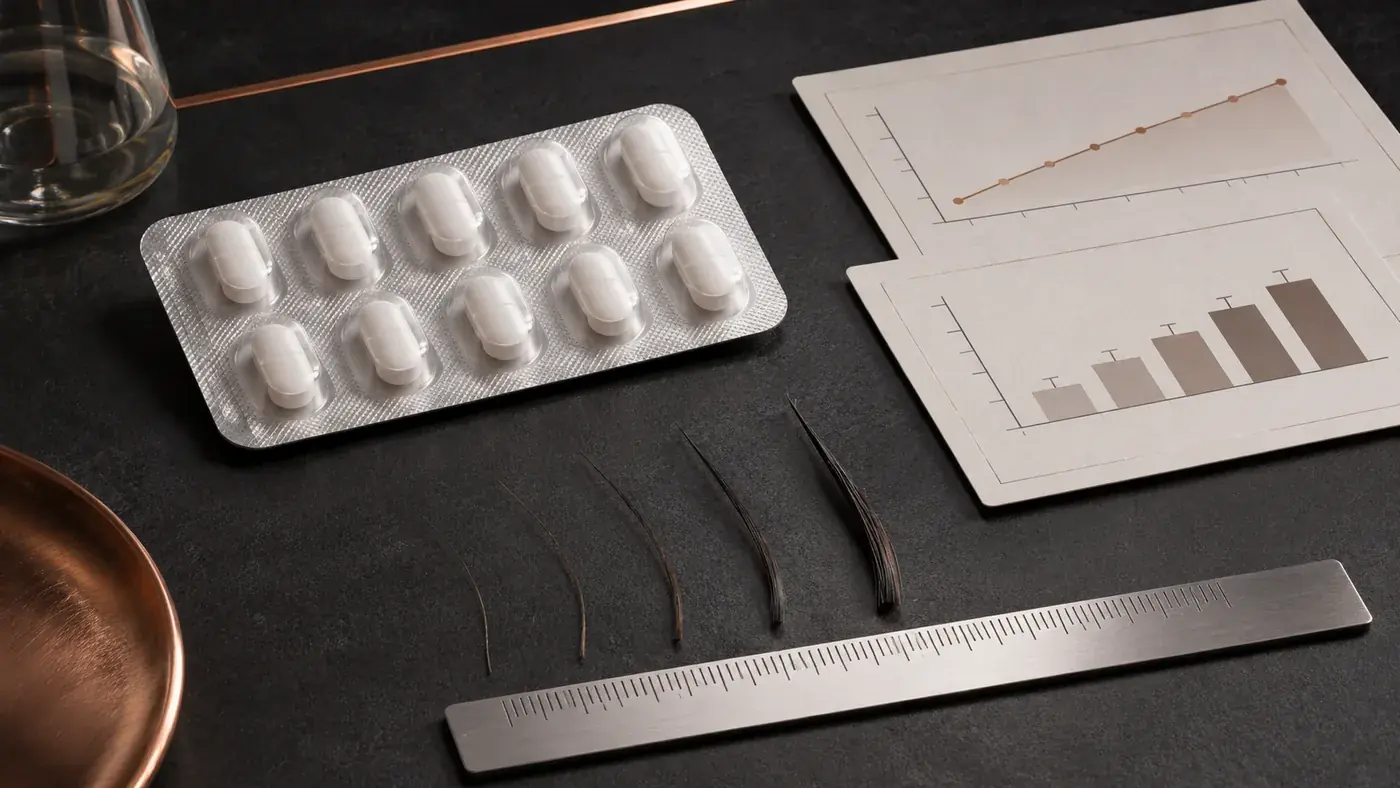
The two original AI-generated NOCTI images are people-free editorial illustrations. They do not show VDPHL01, real trial materials, participant hair, a medical product or evidence from Study 302.
Source
Source: Veradermics SEC filings, ClinicalTrials.gov, U.S. Food and Drug Administration and American Academy of Dermatology, edited by NOCTI.
Republishing: please credit NOCTI (joinnocti.com).
Promising data are not a prescription.
Hair loss can have several causes, and VDPHL01 is not available outside research. Ask a dermatologist what diagnosis fits, which approved or off-label options are reasonable for you, what monitoring matters and how you will judge benefit without letting one good mirror day run the whole meeting.
Read the AAD treatment guide