Caregiving & Infant Safe Sleep
New CDC report finds unsafe sleep factors in at least 73% of reviewed SUID cases
The study cannot assign blame or prove what caused every death. For California dads and caregivers, its practical message is to make every sleep space firm, flat, bare and separate.
A new report adds detail to a difficult public-health problem
CDC researchers reviewed 4,861 sudden unexpected infant deaths recorded during 2020–2024 in 31 jurisdictions that met the registry’s data-quality criteria. SUID is an umbrella term that includes sudden infant death syndrome, accidental suffocation and strangulation in bed, and deaths whose cause remains unknown after investigation. The new report found unsafe sleep factors in at least 73% of the reviewed cases. That is a signal for prevention work—not a claim that one sleep practice explains every SUID or that the registry represents every U.S. infant death.
The 73% figure describes factors present—not a verdict about cause
The report’s categories preserve an important distinction. Forty-four percent of cases were unexplained deaths with unsafe sleep factors and no or unknown airway obstruction; another 10% were unexplained possible suffocations with unsafe sleep factors. Nineteen percent were classified as explained suffocation with unsafe sleep factors. Information about airway obstruction was missing or unknown in 33% of cases. Those limits are why the researchers describe factors observed in the sleep environment separately from a confirmed cause of death.
The sleep-space details are concrete
Among the reviewed SUID cases, 78% involved soft bedding, 75% involved a sleep surface other than a crib, 59% involved sharing a sleep surface and 46% involved an infant found in a nonsupine position. These circumstances overlap, so the percentages should not be added together. They describe what investigators documented at or around the time of death; they are not a calculation of the risk attached to one blanket, position or family. Their practical value is showing which parts of a sleep setup caregivers can check before every nap and night.
California’s number comes from a separate state record
The California Department of Public Health reports 218 sudden unexpected infant deaths statewide in 2023. That state count comes from a different year and data system than the CDC case-registry analysis, so the two figures should not be combined. Sacramento and San Francisco counties contributed cases to the multijurisdictional registry, but the report does not publish a California, Orange County, Irvine or Los Angeles rate from this analysis. The California relevance is the state’s current prevention guidance—not an invented local trend.
For dads and every caregiver, make one setup the default
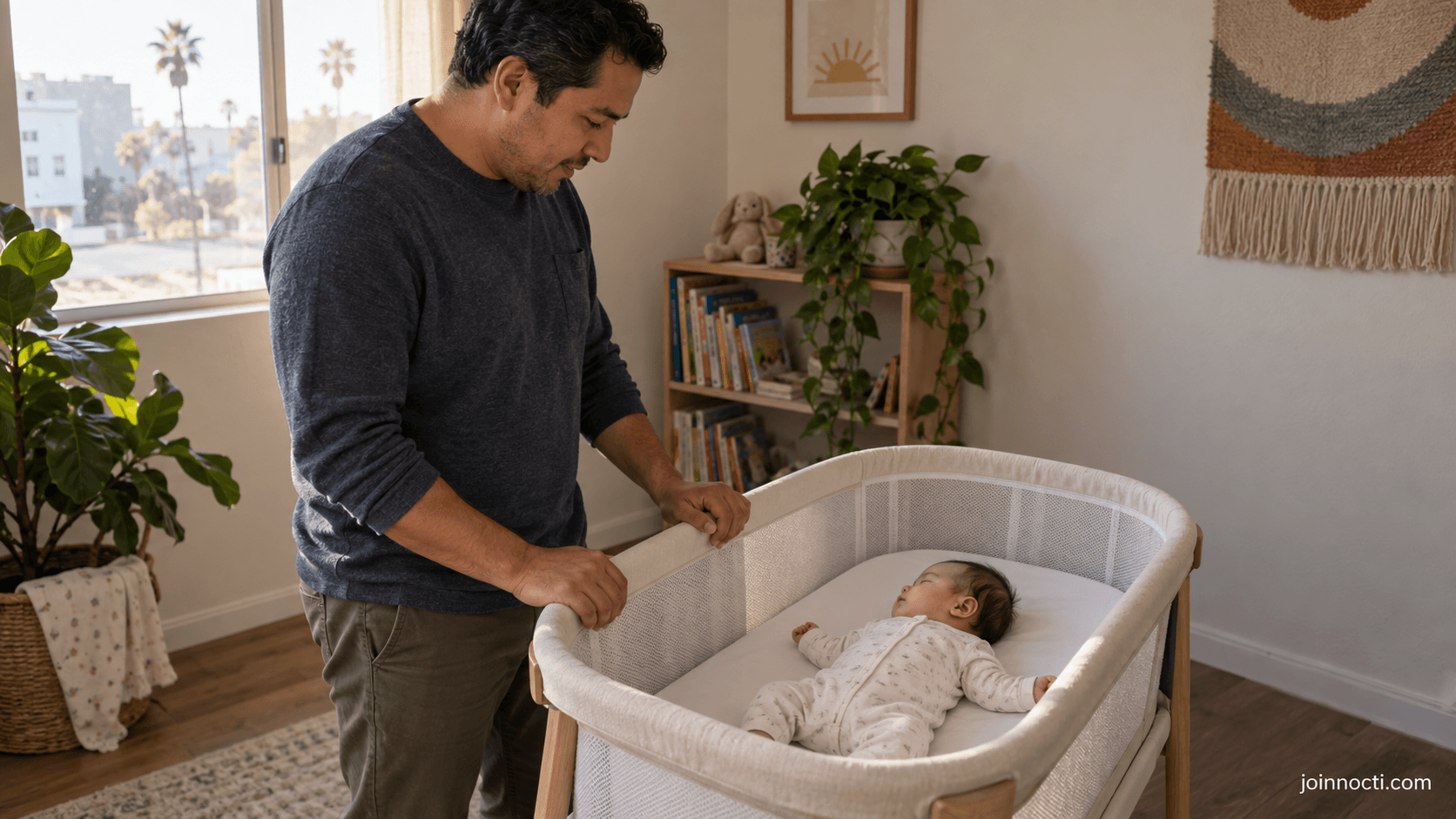
California and federal guidance is consistent: place a baby on their back for every sleep, use a firm and flat mattress in a safety-approved crib, bassinet or play yard, and keep the sleep space bare except for a fitted sheet. Keep the baby’s sleep area in the caregiver’s room, but use a separate surface rather than an adult bed. The same plan should travel with the child: grandparents, relatives, babysitters and child-care staff need to know that naps follow the same rules as nighttime sleep.
Plan for the exhausted handoff
Infant care can be relentless, and safe-sleep conversations work better when they account for fatigue instead of shaming it. Avoid falling asleep with a baby on a couch or armchair. If a baby falls asleep in a car seat, stroller, swing, carrier or another sitting device, CDC and CDPH advise moving the baby to a firm, flat sleep surface as soon as possible. If a caregiver falls asleep while feeding in bed, California guidance says to return the baby to their own sleep space as soon as the caregiver wakes. Before the overnight shift starts, clear the bassinet, decide who will handle the next feeding and make the safe transfer the routine.
Treat product and special-positioning claims cautiously
CPSC says infant sleep products should meet a federal sleep-product standard and advises “Bare is Best”: no pillows, blankets, bumpers, toys or sleep positioners. CDC and CDPH also say not to use weighted blankets, weighted swaddles or weighted sleepers for infants. A monitor, breathing tracker or marketing claim does not make an unsafe surface safe or prevent SIDS. Check cribs and sleep products for recalls through CPSC, and ask the baby’s pediatric clinician about reflux, prematurity, breathing concerns or another medical need rather than improvising an incline, wedge or home monitor plan from an advertisement.
Risk reduction is not a guarantee—and grief is not evidence of fault
NIH’s Safe to Sleep program is explicit that there is no definitive way to prevent SIDS and that a family is not to blame when a baby dies from it. A safer environment can reduce risk, while some sudden infant deaths remain unexplained even after a thorough investigation. California’s SIDS Program offers information for families and works through local health jurisdictions on education and support. If a baby is unresponsive, is not breathing normally, turns blue or has another immediate emergency, call 911. This article is educational service journalism, not pediatric advice, diagnosis or emergency instruction; NOCTI and independent massage or wellness providers do not evaluate or treat infants.
Sources
- CDC MMWR: Characteristics of Sudden Unexpected Infant Deaths—United States, 2020–2024 (September 10, 2026) ↗
- CDC: creating a safe sleep area for babies ↗
- California Department of Public Health: Safe Sleep for Babies and 2023 state SUID count ↗
- California Department of Public Health: SIDS Program, family education and local-health-jurisdiction support ↗
- U.S. Consumer Product Safety Commission: safe sleep products and bare sleep spaces ↗
- NIH Safe to Sleep: three practical steps for dads ↗
- NIH Safe to Sleep: SIDS questions, product claims and family-support boundaries ↗
- American Academy of Pediatrics: current parent guide to safe infant sleep ↗
Find men's massage near you
Compare local providers privately and contact the professional you choose directly.
Search NOCTI