NOCTI / Fashion, culture & gay life
Connor Storrie: Beyond the Heartthrob
Who is the man behind the image—and why has he given so many people a reason to look?
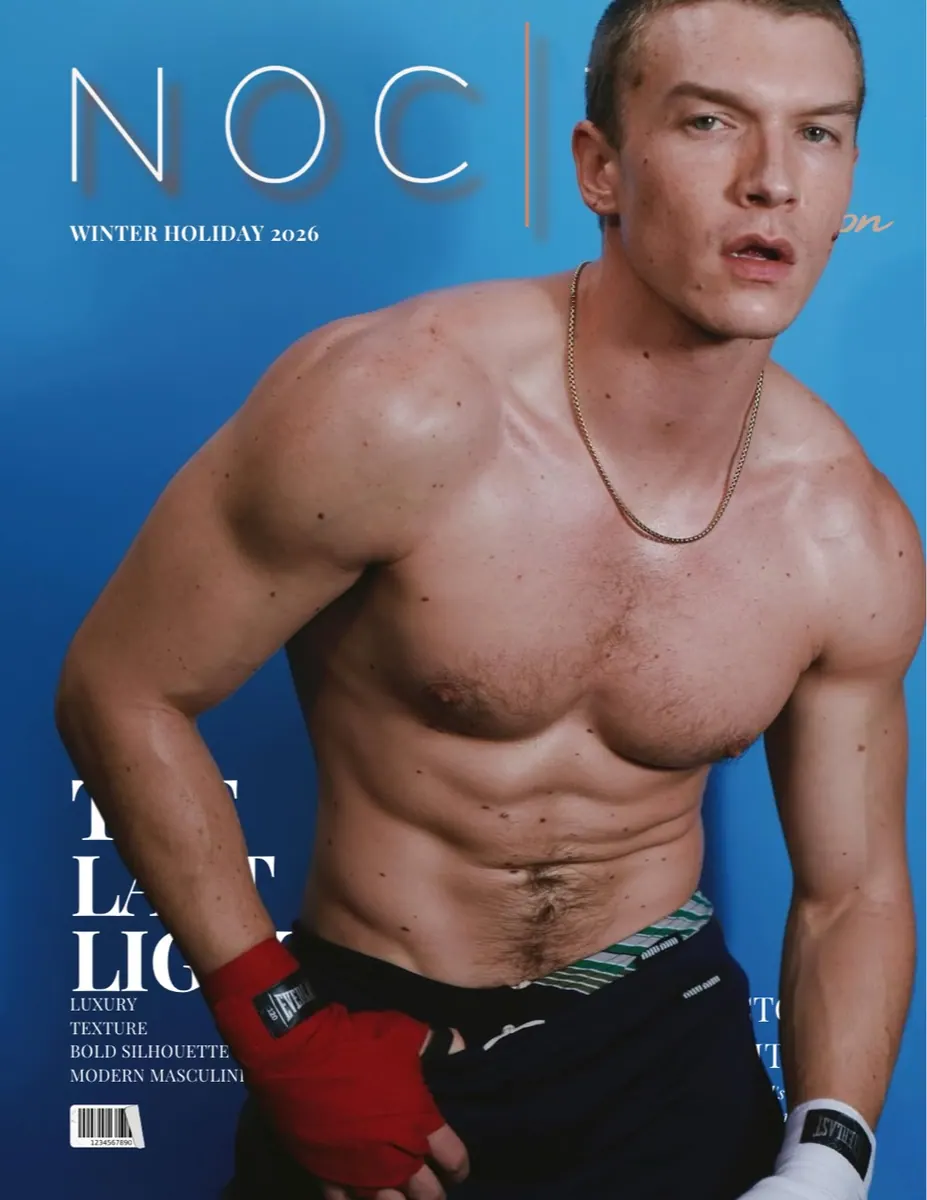
Photography: Collier Schorr for Vogue. Styling: Spencer Singer. Cover presentation: NOCTI.
View photo story →Before the cover
First you notice him. Then you want to know why.
A face on your feed. A name someone keeps mentioning. A romance you may not have watched yet. If Connor Storrie is new to you, this is where the story begins.
From an actor working between auditions to Ilya in Heated Rivalry and the subject of a Vogue fashion story, we explore the rise—and what it opens up for a conversation about desire, tenderness and being seen.
01 / The NOCTI perspective
First, who is Connor Storrie?
He is the actor behind Ilya Rozanov—and his story begins before the photograph that stopped your scroll.
You do not need to have watched Heated Rivalry to understand the appeal of these pictures. There is a face that holds your attention, a body in motion and an ease that makes the clothes seem less like instructions. But if the name is new to you, the missing context matters. A beautiful image becomes more interesting when you know something about the work that brought its subject here.
Connor Storrie is an American actor who grew up in Odessa, Texas. In a December 2025 interview with Variety, he recalled working as a waiter in Los Angeles while pursuing acting. The offer to play Ilya arrived just after a difficult conversation with his restaurant manager. He had also appeared in Joker: Folie à Deux before the series changed his public profile.
That is a useful place to begin: with an actor trying to get work. Celebrity coverage often starts at the moment everyone is looking, as though the person came into existence alongside the attention. A job between auditions is less photogenic than a magazine cover, but it gives the cover a different weight.
What interests NOCTI is the distance between those two images of a working life. One involves being evaluated for a shift. The other involves being evaluated by an audience. Recognition changes the scale, but the question of what people see in you does not simply disappear.
02 / The NOCTI perspective
The role that made the name travel
Heated Rivalry gave viewers a romance to follow, not simply a face to remember.
For newcomers, the premise is straightforward. In the series’ official description, Ilya Rozanov and Shane Hollander are rival professional hockey stars whose secret attraction develops into a relationship over years. Storrie plays Ilya; Hudson Williams plays Shane. Jacob Tierney adapted the story from Rachel Reid’s fiction. Canada Media Fund describes the first season, released in November 2025, as six episodes.
The setting gives the romance a particular pressure. These are men whose public lives are organised around performance, competition and being watched. Attraction creates a private space inside that public world. The audience is invited to care about what happens there, and about whether that space can become a life.
Our reading of the premise is that its appeal rests on a recognisable contradiction: you can be admired by many people and still be afraid of being fully known by one. You do not need to play hockey, or resemble either character, to understand that tension.
This helps explain why a short clip and a whole story offer different kinds of attachment. A clip can sell confidence in seconds. A romance asks whether that confidence can survive tenderness, uncertainty and wanting something you cannot control.
03 / The NOCTI perspective
Why did people pay attention—and keep paying attention?
Attraction may bring someone to a story. Emotional investment gives them a reason to return.
It would be coy to pretend sex and physical appeal have nothing to do with the attention around an adult romance. They are part of its language. NOCTI does not think desire needs to be apologised for before a love story can be taken seriously.
But calling an actor a heartthrob can become a way of stopping the conversation just as it gets interesting. It describes a response to him while telling us very little about his contribution. Was there a choice in the performance that made a character feel less predictable? Did the relationship leave a viewer thinking about something in their own life?
In its November 2026 reporting, Canada Media Fund described Heated Rivalry as Crave’s most-watched original series. That gives the attention a basis beyond our impression of a busy social feed. It does not tell us that every viewer watched for the same reason.
NOCTI’s view is that a successful romantic lead gives desire somewhere to go. The viewer can enjoy looking and also begin to ask: will this person be understood, will the affection be returned, and can this relationship hold more than its most exciting moments? Those are reasons to stay with a story after the first rush has passed.
04 / The NOCTI perspective
The work hiding inside the chemistry
What looks effortless on screen can be the result of very deliberate collaboration.
The Canadian Press interviewed casting directors Jenny Lewis and Sara Kay about finding the leads. They described an international search with hundreds of audition tapes, followed by a Zoom chemistry read in which Storrie and Williams responded generously to each other. Their account also emphasised Storrie’s acting and his preparation of Russian dialogue and an accent for Ilya.
That detail changes how we might look at the finished image of a star. An accent, a rhythm of speech, the timing of a reaction and the willingness to listen to another performer are all work. A still photograph cannot show most of it.
In the same Variety interview, Storrie discussed agreed boundaries and the practical choreography involved in intimate scenes. That is worth remembering when viewers describe chemistry as though it were something a camera simply caught by accident.
For NOCTI, the more interesting version of confidence includes trust. Someone can look assured because the people around them are communicating well, because the expectations are clear, and because there is room to say what does not feel right. That is a richer idea of presence than never admitting discomfort.
05 / The NOCTI perspective
Why this reaches beyond entertainment for a gay reader
Sometimes the fantasy is being wanted. Sometimes it is being able to stay.
A gay lifestyle publication should be able to enjoy a handsome man without treating that enjoyment as its entire editorial purpose. We also want to ask what kinds of relationships, possibilities and everyday experiences the images around us make easier to imagine.
A viewer might be drawn to the erotic charge of a romance. Another might recognise the careful separation between a public self and a private relationship. Someone else may simply want the familiar pleasure of rooting for two people. These responses can coexist. No individual viewer owes us a profound explanation for enjoying a show.
The point that stays with NOCTI is the ordinary life behind the extraordinary attraction. Being desired can be thrilling. Being included in someone’s plans, listened to after a difficult day and welcomed into a shared future offers another kind of reassurance.
That distinction matters to the way we write about gay love. We want room for flirtation and for what comes after it: the conversation, the difficult decision, the quiet assurance that you are more than a secret appointment. Not everyone wants marriage or the same kind of partnership. Everyone should have room to say what they do want.
A screen romance cannot supply that life for its audience. It can, however, provide a starting point for naming a wish. Sometimes knowing what you hope for is already a meaningful step.
06 / The NOCTI perspective
Season 1 gave us the introduction. What changes with season 2?
The next question is what a relationship needs once attraction is no longer the only issue.
As of this November 27, 2026 update, season 2 is in production. Canada Media Fund’s November 5 report identifies The Long Game as its basis and gives spring 2027 as the projected release window. It describes the direction as a more committed, complicated relationship. That is announced context, not a review of episodes that have already aired.
The distinction gives us a more useful comparison than a list of rumours. Season 1 is the existing screen story through which audiences met these characters. Season 2 is the next chapter being made, with expectations attached to it. A projected season is not a confirmed premiere date.
What NOCTI hopes to find in that next chapter is room for the decisions that make romance substantial. What does each person need? Where do their priorities differ? How do they negotiate visibility, privacy and a future together? Those are our questions, not claims about scenes we have seen.
The possibility is compelling because a lasting relationship cannot live on anticipation alone. At some point, wanting another person has to become a way of treating them. That is where a romance can keep its heat while gaining emotional weight.
07 / The NOCTI perspective
Then comes the fashion image
A new wardrobe gives the public another way to see him.
Vogue’s November 23, 2026 Best Dressed feature pairs Storrie with photographer Collier Schorr and stylist Spencer Singer. Chloe Malle conducted the interview; Max Berlinger wrote the introduction. NOCTI’s feature responds to that work with independent commentary.
The transition from a screen role to a fashion story is interesting because the frame changes. We are no longer asked to believe we are watching Ilya. We are looking at an actor using pose, clothing and expression in another creative setting.
For a reader who discovered him through the series, that can be a small adjustment. The familiar face arrives without the familiar character’s explanation. A jacket, a gesture or an unexpected colour has to establish the mood instead.
Our interest lies in that freedom. A breakout role can make a person recognisable very quickly. A thoughtful fashion story can let that recognisable person be a little surprising again.
08 / The NOCTI perspective
Look closer: what do the photographs actually do?
The strongest moments happen when familiar codes are put together differently.
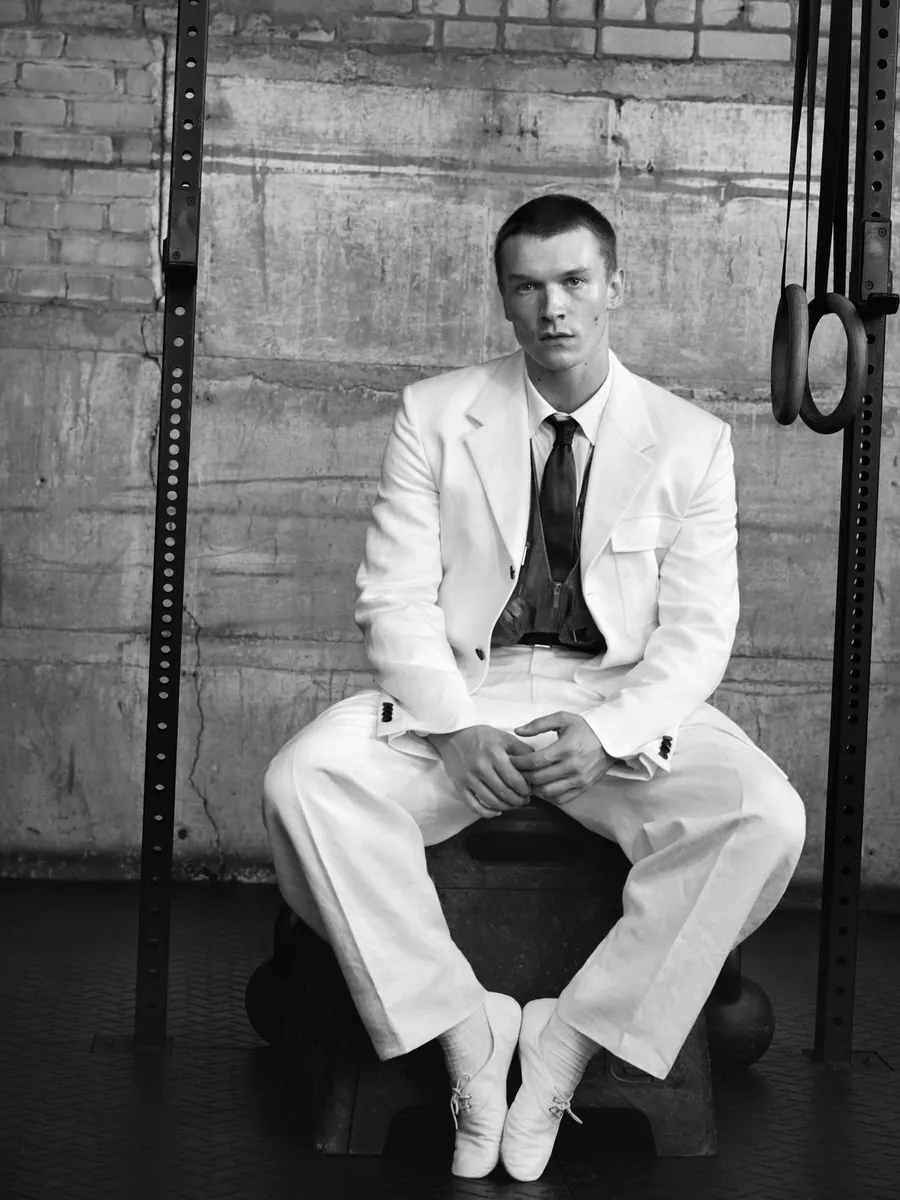
Take the white suit in the gym. The clean tailoring suggests an occasion; the surrounding equipment suggests exertion. Neither element disappears. Their coexistence makes the outfit feel more alert than it might in a predictable formal setting.
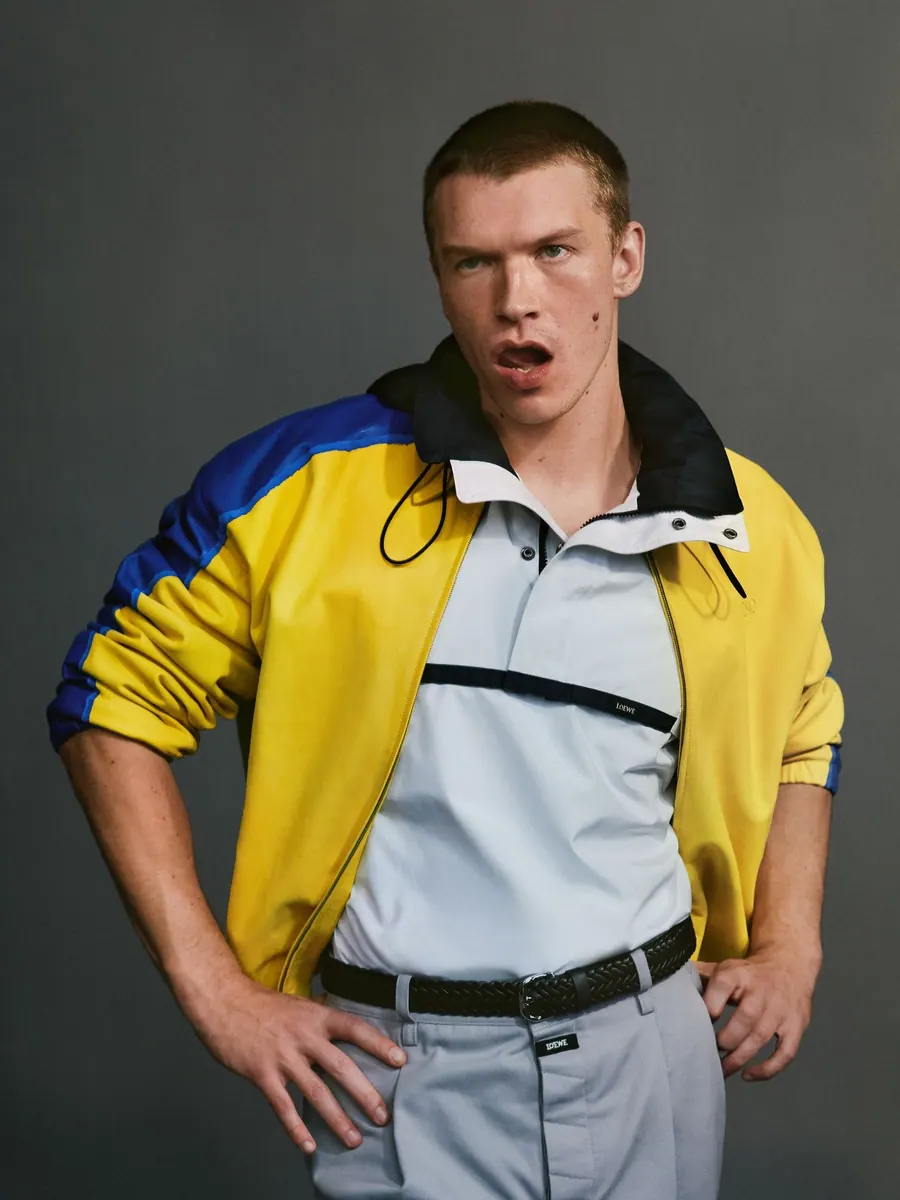
Then look at the yellow-and-blue jacket above gray trousers. The colour introduces a sporting energy, while the trouser line keeps the image controlled. It offers a practical styling idea as well as a striking picture: one vivid piece can change an outfit without requiring every other piece to compete.
The images against blue work differently. Boxing wraps and suspended poses draw attention to the body, but they also give the photographs a sense of activity. A limb, a folded trouser leg or the tilt of the head creates a line for the eye to follow. We are reading movement as much as muscle.
In the closer portraits, the visual work becomes quieter. A raised collar frames a face. Layered fabric changes the shape around the neck. The clothing is not merely decoration added after the portrait; it helps organise what we notice.
NOCTI’s interpretation is that the sequence succeeds when it allows strength and playfulness to share the frame. The subject does not have to look solemn in every photograph to retain presence. That is an appealing proposition for menswear: you can take the clothes seriously and still enjoy yourself.
09 / The NOCTI perspective
Admiration should not become an entrance requirement
You can enjoy this body of images without measuring your body against it.
There is a contradiction that a magazine like ours should be willing to acknowledge. We publish carefully selected photographs of an attractive actor, then tell the reader to be comfortable as themselves. Those two gestures do not automatically cancel each other out, but neither should we pretend there is no tension.
The useful response is to be specific about what the image offers. Here, we can talk about a proportion, a colour pairing or a way of moving. We should not suggest that the reader needs the same build, age or face before any of those ideas become available to them.
Nor should we turn the body into a moral achievement. A photograph does not tell us how kind someone is, how good a partner they will be or whether their life feels secure. Attraction is real; the stories we attach to it need a little more care.
For NOCTI, a good fashion page should send you back into your own life with more curiosity and less self-contempt. If the only lesson you take away is that you are insufficient, we have missed an opportunity to do something useful with a beautiful image.
10 / The NOCTI perspective
The character, the actor and the person we do not know
Being visible is not the same as making every part of your life public.
It is easy for the chemistry of a fictional relationship to follow its actors into interviews and photographs. Viewers already know how to read the pair as romantic leads, so an ordinary gesture can acquire a story before anyone involved has told one.
NOCTI can discuss a gay romance, its cultural appeal and the fashion work of its actors without assigning those actors a sexuality or a private relationship. The distinction does not make the coverage less warm. It makes room for a person to be more than our preferred explanation of them.
There is a useful lesson here for everyday life too. Someone can be expressive, affectionate or comfortable with their appearance without owing us an identity label. Curiosity is human. Leaving room for someone else to define themselves is a choice we can make.
11 / The NOCTI perspective
Bring one idea back to your own wardrobe
The most useful souvenir is a detail you can make yours.
Choose a single photograph and name the thing you like before looking for a product. Perhaps it is the contrast of a bright jacket with gray trousers. Perhaps it is the length of a trouser leg, a collar held away from the neck or a formal piece worn with something relaxed. The clearer the idea, the less likely you are to buy a pile of unrelated clothes.
Try the idea with what you own. Look at the outfit standing and sitting. Walk in it. Check how the fabrics feel and whether the shoes fit the day you actually have planned. An editorial pose is one moment; a useful outfit has to last beyond it.
If you take an image to a barber or stylist, explain the feeling you want as well as the detail. More deliberate? More playful? Less effort in the morning? Ask how they would adapt the reference to your hair, proportions, routine and budget.
You can admire the confidence of a celebrity image while building a quieter version of it for yourself. The goal is to recognise yourself in the mirror, with perhaps one pleasant surprise.
12 / The NOCTI perspective
What NOCTI sees when the pictures end
A reason to look more closely at the person—and a little more kindly at ourselves.
Connor Storrie’s appeal begins, for many readers, with a role or a photograph. Looking further brings the work into view: the pursuit of an acting career, the collaboration that creates screen chemistry and the creative choices that make a fashion sequence feel alive.
Our particular interest is in the link between being looked at and being understood. They can overlap, but they are not identical. A person can attract attention and still want to be heard. A reader can appreciate beauty and still need a reminder that a worthwhile life is not reserved for the people on the cover.
That is the feeling we want this story to leave with you. Enjoy the photographs. Follow the next season when it arrives. Try the jacket, or keep your favourite old one. There is no requirement to turn admiration into imitation.
And when the screen goes dark, make room for something that belongs to your own life: an honest conversation, a date you are looking forward to, a friend you can be affectionate with, a look that makes you stand a little more comfortably.
Being wanted is a lovely feeling. Being known, respected and able to remain yourself is a future worth imagining too.
Original photography by Collier Schorr for Vogue; styling by Spencer Singer. Makeup: Yumi Lee. Grooming: Kumi Craig. Set design: Javier Irigoyen. Tailoring: Tae Yoshida. Production: Hen’s Tooth Productions. Original interview: Chloe Malle; introductory text: Max Berlinger.
NOCTI’s independent commentary and cover presentation accompany the original fashion photographs. The Vogue covers in the album retain their original mastheads.
Source: Variety; The Canadian Press; Heated Rivalry’s official series description; Canada Media Fund; Vogue, edited by NOCTI.
Republishing: please credit NOCTI (joinnocti.com). Photography rights remain with their respective holders; this article’s credit line does not grant reuse of the photographs.