Groom Journal / Waxing
Body hair. Your call.
Smooth skin can be a preference. It does not have to be a requirement. A closer look at the hair, the pressure and the choices in between.
- Hair removal is a choice, not a cleanliness test.
- Compare the upkeep as well as the finish.
- A good appointment starts with privacy and clear boundaries.

One man spends his Sunday removing the hair another man wishes he had. Both can end up feeling that their natural body needs an explanation. Before choosing a method, it helps to separate what you like from what you have been told to like.
This is a guide to body waxing, not body wash. It starts with a simple permission: you can enjoy being smooth, prefer some hair, or leave it alone. Each choice deserves better information than a before-and-after advertisement.
A body with hair is an ordinary body.
Body hair has functions beyond appearance, including sensation and protection. Fine, light hair and thicker, pigmented hair can coexist on the same person. Age, hormones, inherited characteristics and health can affect the pattern you notice.
Hair removal is not a routine medical requirement for healthy skin. Washing and caring for the skin still matter whether you remove the hair or keep it. Smoothness is a finish; it is not a reliable measure of hygiene, attractiveness or masculinity.
That distinction changes the decision. Instead of asking whether your body is acceptable, ask what result you actually want: less bulk, a particular look, a different feel, or less time spent grooming.
Four routes. Different kinds of upkeep.
Shaving cuts the visible hair. Waxing pulls the hair out from below the surface, while leaving a follicle that can produce hair again. A longer interval before visible regrowth is the appeal; permanent removal is not a promise waxing can make.
Trimming is worth considering if you want a tidier outline without a completely bare finish. It still involves a tool near the skin, so it is not injury-proof. Laser is a separate, longer-term decision that needs assessment of the actual skin, hair and practitioner’s experience.
| Method | What changes | What to weigh |
|---|---|---|
| Leave it | Your natural hair pattern stays. | No removal appointment or regrowth cycle to maintain. |
| Trim | Shortens the hair above the skin. | Leaves visible hair; use care around folds and sensitive skin. |
| Shave | Cuts the shaft close to the surface. | Frequent upkeep; cuts, irritation and ingrown hairs are possible. |
| Wax | Removes the hair from below the surface. | A result lasting weeks for some; pain, irritation and skin injury are possible. |
| Laser | Targets pigmented hair with light. | Multiple treatments; suitability, burns and pigment changes need a professional discussion. |
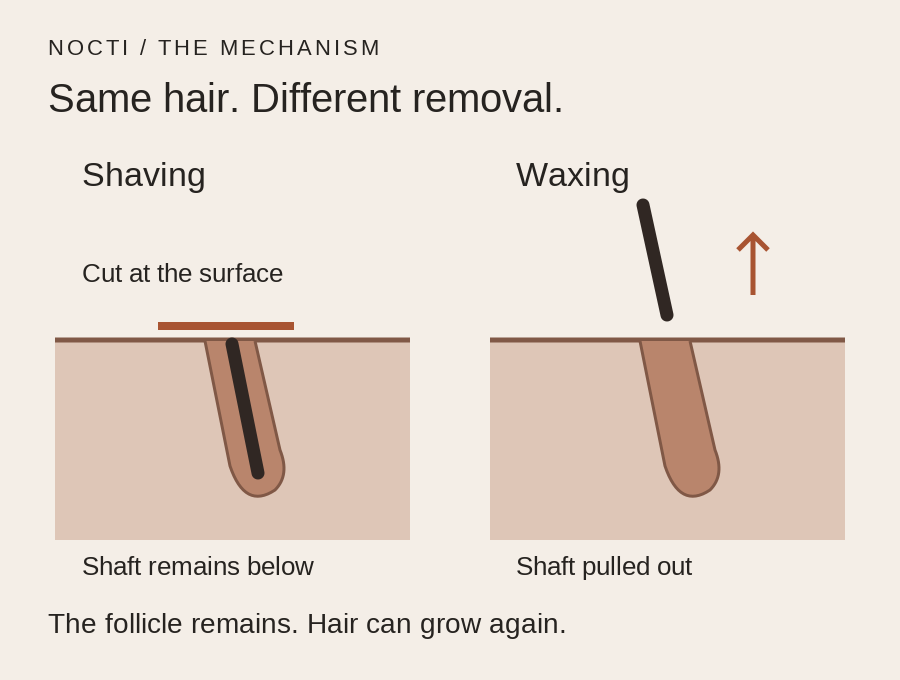
Open full-size graphic ↗
Whose idea of “well groomed” is it?
A public r/malegrooming discussion about an elaborate routine drew very different reactions: some people enjoyed the maintenance, others questioned the time and expense, and some preferred body hair. Those comments are useful for finding questions, not counting what men in general believe.
A useful way to examine the pressure is to ask who gets to set the standard. A partner may have a preference. A salon sells a service. A carefully lit model image sells a look. None of those tells you what will feel comfortable on your own skin on an ordinary Tuesday.
Wanting a different look can be playful, practical or important to your identity. It can also become tiring when the maintenance is mainly about avoiding judgment. The same waxing appointment can mean different things to different people; appearance alone cannot reveal the motive.
There is no single gay, straight or Asian preference. Describing Asian men as naturally smooth turns a large, varied group into a promise about an individual body. You do not owe anyone that promise.
More hair after a move? The timing is not the cause.
Noticing more hair after relocating is a real observation. It does not establish that a colder, warmer or drier climate caused it. The sources reviewed here do not establish that migration itself creates new follicles.
Age, hormonal changes, medications and changes in health belong in the explanation before a confident weather story. Different light, grooming habits or attention to your body are also possible explanations for noticing a change; they are possibilities, not a diagnosis.
If growth changes abruptly, is substantial, or arrives with other symptoms, discuss it with a healthcare professional. A photograph, your ethnicity or the place you moved to cannot settle the cause.
What the injury research actually measured.
A U.S. survey published in JAMA Dermatology in 2017 found that 25.6% of people who groomed their pubic hair reported a grooming-related injury. The weighted estimate was 23.7% for men and 27.1% for women. Of 5,674 groomers, 79 reported an injury that required medical attention.
These were reports of past injuries across grooming methods, collected in 2014. The figures are not the chance of being injured at your next wax, do not isolate professional body waxing, and cannot rank salons. Self-report and a cross-sectional design also limit what can be concluded about cause.
The useful lesson is proportionate: grooming can have costs beyond money. Most reported injuries did not require medical attention, but technique, body area and the amount of grooming deserve consideration.
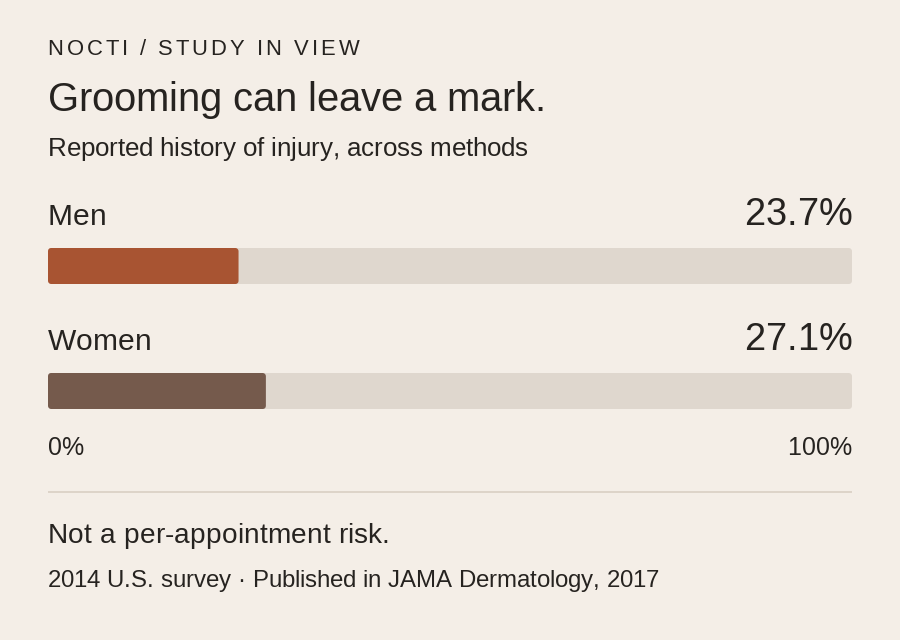
Open full-size graphic ↗
Make room for the less photogenic details.
Waxing can cause burns, skin tearing, folliculitis, ingrown hairs and dark marks after inflammation. Curved hairs can re-enter the skin after removal. A recurring bump deserves an explanation, rather than increasingly aggressive scrubbing or digging at it.
Tell the practitioner about medications, retinoids, recent procedures and irritated skin before booking. AAD advises against waxing during or within six months of isotretinoin use. Facial retinol or prescription retinoids can also make waxing unsafe; confirm the plan with your prescriber instead of stopping a prescription on your own.
Do not wax damaged or sunburned skin. Ask about single-use applicators: dipping a used stick back into a shared wax pot can transfer germs, and heating the wax does not make that practice hygienic.
Afterward, avoid friction and heat on irritated skin, follow appropriate aftercare and resist picking. Redness or swelling lasting more than two days is a reason to contact a dermatologist. Rapidly spreading redness, fever, severe pain or a significant burn needs prompt medical assessment.
A first appointment should feel predictable.
Embarrassment often comes from missing information. Will the salon accept male clients? Which areas are included? How much clothing is removed? Who will be in the room? Those are reasonable service questions, not awkward favors.
You may prefer a practitioner of a particular gender. That preference can help you feel comfortable, but it does not establish skill. Ask about training, experience with the area you want treated, hygiene, privacy and the ability to pause. A competent professional should be able to explain the service without shaming your body.
For intimate services, agree on scope and draping beforehand. You can decline a step or stop. Staff also have a right to professional boundaries and a safe workplace. Clear communication protects both people.
- “Do you provide this service for men, and what areas are included?”
- “Who will perform it, and what training or license applies here?”
- “How do you protect privacy and prevent double dipping?”
- “Which medicines or skin conditions should I tell you about?”
- “What is the full price, and who do I contact if my skin reacts?”
Price the routine, not just the appointment.
There is no single national price for a male wax. Area, location, time, practitioner and what the service includes all matter. A bargain for a small area is not a quote for the whole body, and a booking marketplace is not a representative price survey.
For an illustration, an $80 appointment repeated ten times costs $800 before travel, tips or aftercare. That is arithmetic, not a recommended schedule or an average market price. Add your travel time, the grow-out period and how your skin feels afterward.
A useful outcome might be a wax you enjoy. It might be a trim that takes five minutes, fewer appointments, or deciding that your body hair can stay. Good information should leave all of those choices open.
A few useful answers.
Does waxing remove hair permanently?
No reliable permanent result should be promised. Waxing is a temporary removal method; regrowth and intervals vary.
Is waxing always better than shaving?
No. The finish, maintenance, skin response and cost differ. Recurrent irritation is a reason to reconsider the method with a dermatologist.
Can I wax while using retinoids?
Discuss the exact product and body area with your prescriber and practitioner first. Do not stop prescribed medication on your own to fit a salon appointment.
Do the injury percentages describe a single waxing appointment?
No. They describe a history of injuries across pubic-hair grooming methods in a 2014 U.S. survey, published in 2017.
About this article
An editorial review of published guidance and research, checked November 17, 2026. This is general information, not a diagnosis or an individualized treatment plan. No clinician review of this NOCTI article is claimed.
The charts and explanatory drawing are original NOCTI graphics with sources identified below them. The cover is a service illustration. No salon advertisement, model image or social-media testimonial is presented as proof of safety or effectiveness.
We did not conduct interviews or a representative social-media study. The linked Reddit discussion illustrates varied opinions; no claim is made about prevalence on X or Instagram. The budget example is hypothetical.
Sources (7)Read moreRead less
- Cleveland Clinic — Body hair
Medical overview updated September 15, 2025. Biology and changes with age, hormones and health; not evidence that relocation causes hair growth.
- American Academy of Dermatology — 6 ways to remove unwanted hair
Consumer guidance on method differences and salon hygiene. Individual suitability requires assessment.
- DermNet — Waxing
Mechanism, temporary results and adverse effects. Medication advice differs across sources; obtain an individual prescriber plan.
- Reddit — Thoughts on men and grooming in general
Public discussion, October 7, 2023. Self-selected opinions, not a population survey or medical evidence.
- Truesdale et al. — Grooming-related injuries, JAMA Dermatology (2017)
Cross-sectional U.S. survey collected in January 2014. DOI 10.1001/jamadermatol.2017.2815. Chart redrawn from published numerical results.
- American Academy of Dermatology — Hair removal: How to wax
Skin precautions, medication cautions and when persistent redness or swelling needs assessment.
- Ogunbiyi — Pseudofolliculitis barbae: current treatment options (2019)
Clinical review of ingrown-hair mechanisms, chiefly beard-area disease. Does not establish one best method for every body area.