Groom Journal / Skincare
Good skin. Less guesswork.
Start with care you can keep up. Then decide what, if anything, you want beyond it. A clear-eyed guide to the routine, the treatments and the pressure.
- A simple routine is a sensible starting point.
- Makeup and facials are personal options.
- Injectables need a separate medical decision.
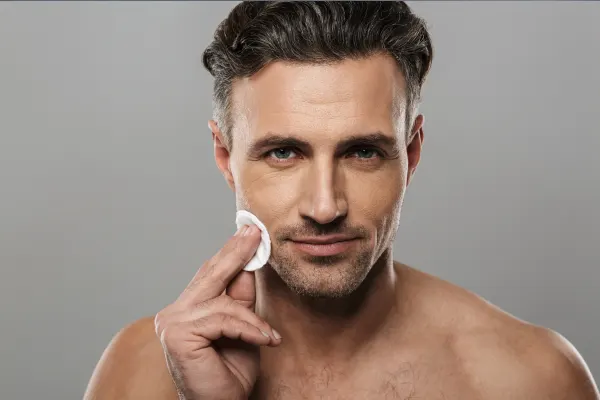
A man can feel embarrassed about caring for his skin, then discover an industry ready to sell him much more care than he needs. The useful middle ground is knowledge: enough to look after yourself, question a sales pitch and choose your own finish.
Skin health, makeup, a relaxing facial and a prescription injection are different decisions. You can want one without wanting the others. You can also enjoy your age showing on your face.
Start with your skin, not the label “for men.”
The American Academy of Dermatology says the basic elements of an effective skin-care plan are similar for men and women. Skin type, irritation and the effect of shaving are more useful guides than the color of the bottle.
A practical starting point is a mild cleanser, a moisturizer you tolerate and sun protection. Use lukewarm water and clean gently, including after exercise. For acne-prone skin, look for products labeled non-comedogenic; sensitive skin often benefits from fragrance-free choices.
Outdoors, use broad-spectrum, water-resistant SPF 30 or higher on exposed skin. Reapply about every two hours and after swimming or sweating, and combine it with shade and protective clothing. Do not forget the ears, neck or an exposed scalp.
New, changing, bleeding or persistently troublesome spots deserve medical attention. A cosmetic routine is not a way to diagnose them.
One place the evidence goes beyond a testimonial.
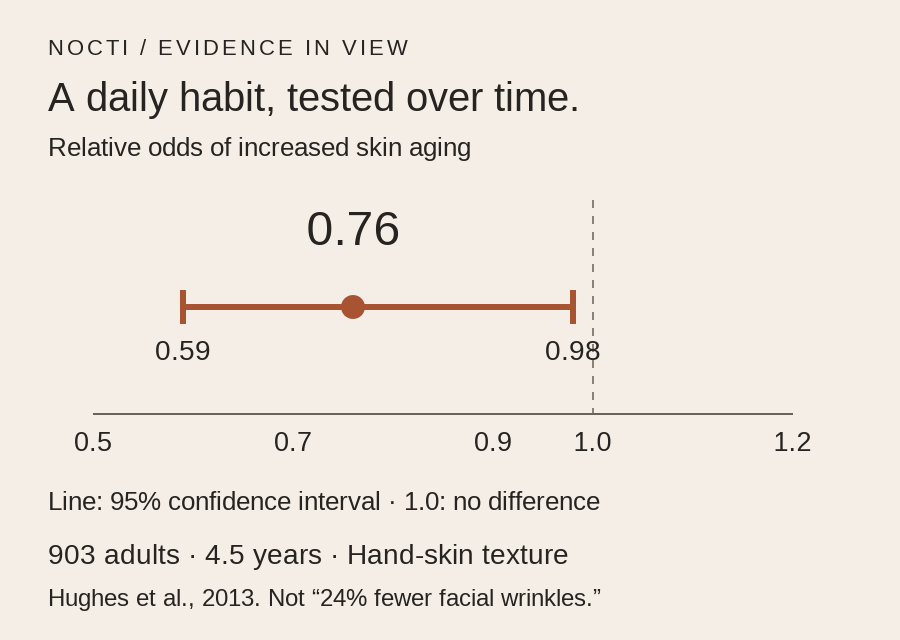
In a randomized Australian trial involving 903 adults younger than 55, researchers compared daily sunscreen use with discretionary use over 4.5 years. They assessed changes in skin texture on the back of the hand, with assessors unaware of the assigned group.
The daily-use group had lower odds of increased skin aging: relative odds 0.76, with a 95% confidence interval of 0.59 to 0.98. That does not mean 24% fewer facial wrinkles, 24% younger skin or a guaranteed result for any individual.
This was a particular population, outcome and follow-up period. It supports consistency with sun protection; it does not tell us that a luxury cream, a facial or an injection produces the same benefit.
Open full-size graphic ↗
More interest does not create a new obligation.
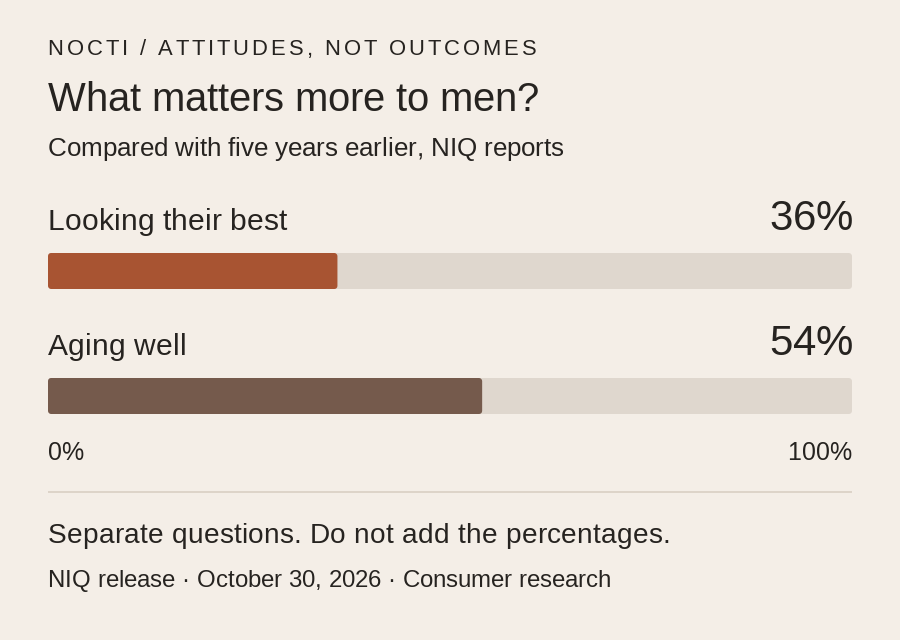
NIQ’s October 30, 2026 release reports that 36% of men surveyed said looking their best had become more important than five years earlier; 54% said the same about aging well. These are attitude findings. They do not show how many men need treatment, or prove that any product works.
A public skincare discussion from a newcomer captures a more everyday concern: where to start, what can be skipped and whether a product needs to be marketed to men. One thread is not a survey, but the uncertainty is a useful problem for an article to solve.
There are several possible explanations for hesitation. Someone may dislike being judged, have a limited budget, dislike the feel of products, or simply have other priorities. Calling every reluctant man insecure would miss those differences.
The helpful change is having more room to choose. It should not become a new rule that a man must look younger, buy more or apologize for wanting either.
Open full-size graphic ↗
Makeup is an option. So is skipping it.
A man writing in r/MakeupAddiction described enjoying a subtle professional makeup application for an event. Replies showed enthusiasm for different levels of visibility, including makeup that is meant to be seen. This is a conversation about taste and experience, not a measure of what everyone finds attractive.
Concealer can temporarily disguise redness, brow gel can change the finish of brows, and tinted products can alter how even the skin looks. That visual effect is different from treating the cause of redness or acne. A tint also does not replace adequate sunscreen application just because the packaging mentions SPF.
You can use makeup for an event, wear it every day, or never try it. Neither the choice nor how visible it is can tell someone your sexuality, character or level of masculinity. The question is whether it serves your preference.
A facial should have a specific purpose.
A facial may offer cleansing, hydration or a pleasant hour away from your phone. Those are legitimate reasons to book. They do not automatically establish a lasting anti-aging benefit or make a monthly appointment necessary.
Ask what each step is intended to do, how long the result is expected to last and what might irritate your skin. Extractions, exfoliating acids and other procedures add different risks. Brand names and the phrase “deep cleansing” are not a diagnosis or a treatment plan.
Persistent acne, eczema, rosacea or unexplained pigment changes deserve appropriate clinical assessment. A dermatologist can determine whether a treatment is needed; repeatedly buying facials may leave the underlying problem unaddressed.
Advice about routine facials is not uniform: Cleveland Clinic’s service overview favors a regular schedule, while a JCI feature interviewing dermatologists questioned broad health claims. Neither is a randomized trial proving that every man needs a monthly facial. A plan for a specific concern is different from a universal requirement.
| Choice | A reasonable purpose | Question before paying |
|---|---|---|
| Daily routine | Cleanse, moisturize and protect. | Does this suit my skin and fit my day? |
| Basic facial | A chosen care or relaxation experience. | What steps, products and temporary results are included? |
| Peel or device treatment | A procedure aimed at a defined concern. | Who assesses suitability, risks and recovery? |
| Dermatology visit | Assessment of a skin problem. | What is the diagnosis and what options follow from it? |
| Cosmetic injection | An elective medical intervention. | What product, licensed clinician and follow-up plan? |
Adding more is not always moving forward.
AAD’s budget guidance favors a simpler approach and warns that using too many products can irritate skin. Cost is not a dependable proxy for effectiveness. A routine you use consistently is more useful than a shelf you cannot make sense of.
Retinoids can help with particular concerns such as acne or photoaging, but irritation, dryness and discoloration after inflammation matter. They are not a compulsory birthday purchase. Match an active to a concern, introduce it cautiously and seek advice if your skin is already sensitive or inflamed.
Tell a practitioner about these products before a peel, a device procedure or facial waxing. A skin-care product that is suitable alone may change the safety of the next service.
Botox deserves its own decision.
Botox Cosmetic is a prescription botulinum toxin product that temporarily reduces muscle activity to soften certain expression lines. It does not treat every source of skin aging, remove sun damage or replace sunscreen. It is optional, and the effect is temporary.
A satisfying experience over many years is meaningful to that person. It cannot establish that the product is risk-free for everyone. In the label’s forehead-plus-frown-line trials, headache was reported by 9% of treated participants versus 5% with placebo; brow droop by 2% versus 0%. Those trial estimates are not a personal risk prediction.
The label carries a boxed warning about distant toxin effects, including potentially life-threatening swallowing or breathing problems. It also notes that definitive serious distant-spread reports had not been identified for the specified labeled dermatologic doses. Both points matter: an important warning should neither be hidden nor confused with a measured complication rate for an ordinary cosmetic visit.
CDC advises checking that the injector is appropriately licensed and trained and that the product comes from an authorized source. Do not buy injections online for self-use. New trouble breathing, swallowing or speaking after an injection needs immediate medical attention.
Filler is a different treatment, not the next required step.
Dermal fillers add volume or change contours; botulinum toxin changes muscle activity. Liking one does not commit you to the other. Nor does preferring Botox establish that fillers are inappropriate for everyone.
FDA describes risks including swelling, bruising, infection and nodules. Rare accidental injection into a blood vessel can cause tissue damage, blindness or stroke. Some materials are difficult or impossible to remove. These are reasons for a careful conversation with a qualified clinician, not a casual add-on at checkout.
Before any elective procedure, be able to explain the change you want, what the product cannot do, the expected duration, the follow-up arrangement and the alternative of doing nothing.
Give the annual cost a little daylight.
A price list can make each appointment look manageable while hiding the cost of repetition. Ask for the full price and what it includes before booking. Location, scope, clinician and product make blanket U.S. price ranges unreliable for an individual decision.
Here is a hypothetical budget, not a market average or a recommended schedule: $15 a month for products is $180 a year. Adding four $100 facials raises that to $580. Adding twelve makes it $1,380, before tips, travel or other procedures. More spending in this example does not imply better health or a better result.
A useful question is: if this service were not fashionable, would I still want the outcome enough to pay for its upkeep? You can enjoy a treatment and still decide it is not the best use of your money this year.
Choose the next step you can explain.
For a newcomer, the next step may be understanding your skin and choosing a manageable routine. For someone with a persistent problem, it may be a clinical appointment. For someone considering aesthetics, it may be a consultation that ends without a procedure.
Care should give you more agency, not another appearance test to pass. Healthy habits, a little makeup, an occasional facial and visible laugh lines can all coexist. The decision belongs with the person wearing the face.
- Name the concern before shopping for a solution.
- Ask what evidence supports the promised outcome.
- Check the practitioner, product and plan for complications.
- Include upkeep and recovery in the price.
- Keep the option to say no.
A few useful answers.
Do men need products labeled “for men”?
The useful starting points are skin type, ingredients, tolerance and the concern being addressed. A gender label does not establish suitability.
Is a facial every month necessary?
No universal schedule follows from the guidance reviewed here. Book for a clear goal; persistent skin disease needs assessment rather than a standard spa subscription.
Does the sunscreen study mean 24% fewer wrinkles?
No. Its estimate concerns relative odds of increased aging assessed from hand-skin texture over 4.5 years in a particular trial population.
Should every man get Botox as he gets older?
No. It is an elective prescription treatment with benefits, limitations and risks. Age alone does not create a need for it.
About this article
An editorial review checked November 17, 2026, not a new study, medical diagnosis or individual recommendation. No clinician review of this NOCTI article is claimed. Advice about a medicine or procedure belongs with an appropriately licensed healthcare professional.
NOCTI created the charts from identified published results. They are not photographs of treatment outcomes. The cover is an illustration, not a testimonial or product endorsement.
Trial evidence, clinical guidance, market research and social-media experience answer different questions. The public discussions are examples, not a prevalence estimate. No comprehensive survey of X or Instagram is claimed. The budget is hypothetical.
Sources (13)Read moreRead less
- American Academy of Dermatology — Skin care tips for men
General routine, skin type, shaving and sun-protection guidance.
- Hughes et al. — Sunscreen and prevention of skin aging (2013)
Randomized Australian trial; 903 adults under 55; 4.5 years. DOI 10.7326/0003-4819-158-11-201306040-00002. Plot redrawn from the published estimate.
- NIQ — The Permission Gap findings, October 30, 2026
Primary corporate research release. Different datasets and geographic scopes; attitudes do not establish treatment need or effectiveness.
- Reddit — Routine Help: Clueless Man
A public request for beginner guidance, not a representative survey. Personal identifiers and medical details are not reproduced.
- Reddit — Subtle makeup on men
A personal account and public discussion; not evidence of general preferences or medical benefit.
- Cleveland Clinic — Facials: What are they, and what do they really do?
Clinical consumer guidance on types of facial, suitability and practitioner choice.
- Neill — Skin care in the aging female: myths and truths (2012)
JCI interview feature discussing claims and evidence; an older perspective focused on women, not a trial in men.
- American Academy of Dermatology — Pimple popping: Why only a dermatologist should do it
Distinguishes appropriate professional treatment from harmful squeezing and picking.
- American Academy of Dermatology — Skin care on a budget
Simple routines and avoiding unnecessary irritation or expense.
- American Academy of Dermatology — Retinoid or retinol?
Uses, skin tolerance and irritation considerations.
- DailyMed — BOTOX Cosmetic prescribing information
Manufacturer’s prescribing information hosted by the U.S. National Library of Medicine. Boxed warning, section 5.2 and Table 7; not an individualized recommendation.
- CDC — How to stay safe when getting botulinum toxin injections
Updated April 22, 2026. Licensing, training, authorized products and symptoms requiring immediate care.
- FDA — Dermal filler do’s and don’ts
Different mechanisms, possible complications and advice on qualified care.