HEALTH / HIV Surveillance & Testing
UK HIV Diagnoses Fell. Why Is 43% Still Late?
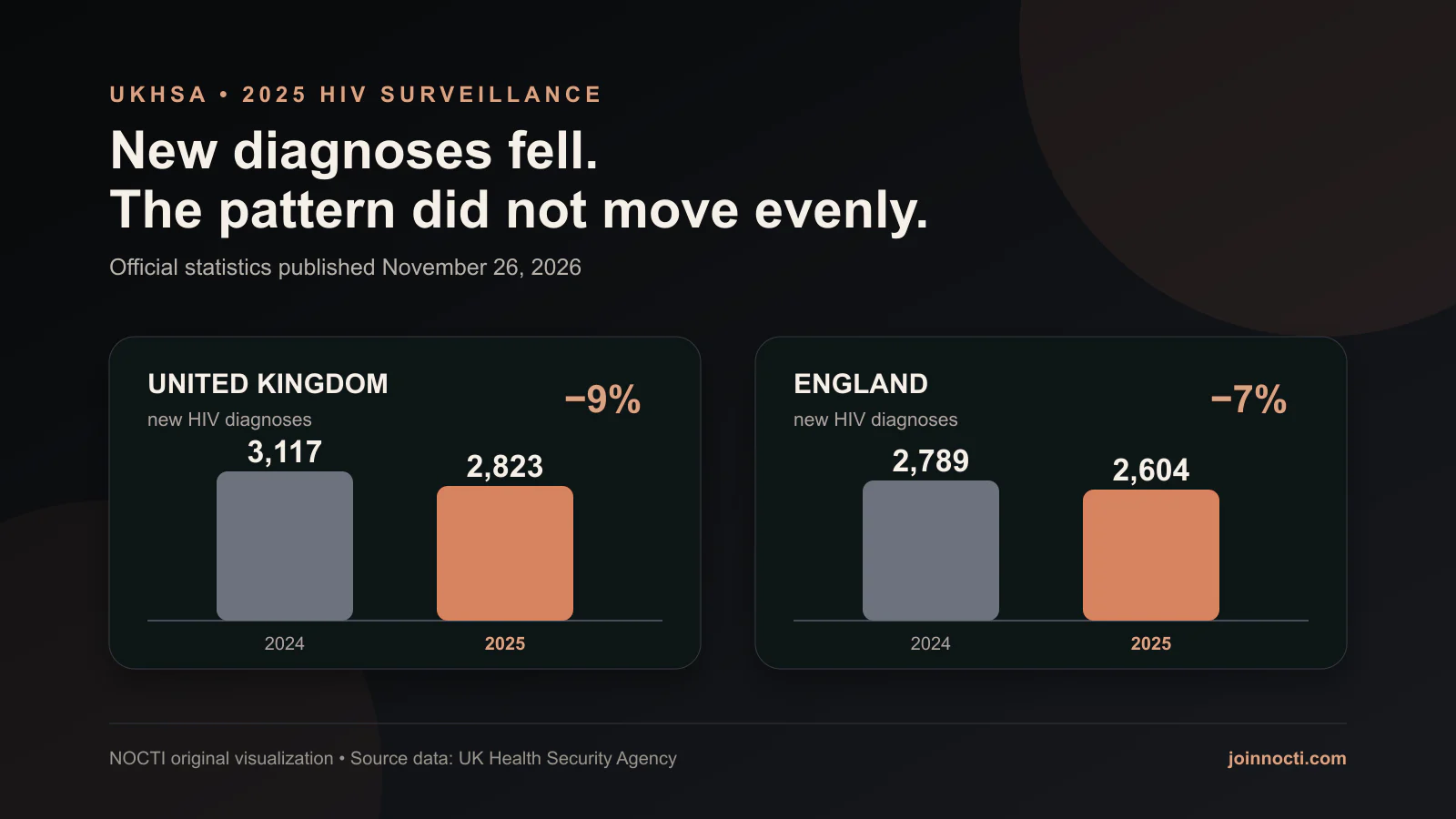
No. UKHSA’s 2025 data show new HIV diagnoses fell 9% across the UK, but 43% of people newly diagnosed in England with a reported CD4 count were still diagnosed late. The headline is progress, not victory: trends differed sharply by group, and diagnosis counts reflect testing and migration as well as transmission.
The short answer
No. UKHSA’s 2025 data show new HIV diagnoses fell 9% across the UK, but 43% of people newly diagnosed in England with a reported CD4 count were still diagnosed late. The headline is progress, not victory: trends differed sharply by group, and diagnosis counts reflect testing and migration as well as transmission.
What did UKHSA publish on November 26?
The UK Health Security Agency published its annual HIV official statistics for 2025 on November 26. It recorded 2,823 new diagnoses across the United Kingdom, down 9% from 3,117 in 2024. In England, new diagnoses fell 7%, from 2,789 to 2,604.
Among all men in England, diagnoses fell 4%, from 1,816 to 1,751. That is a smaller decrease than the 12% fall among all women. Gay and bisexual men accounted for 776 of England’s 2,604 new diagnoses in 2025, or 30%.
Those figures exclude people who had already been diagnosed before continuing HIV care in England. That boundary matters. UKHSA separately counted 1,497 people with a prior diagnosis who continued care in England, and it warns that this group should not be treated as HIV acquired in England.
Why can diagnoses fall while late diagnosis stays high?
Because the headline count and the late-diagnosis share answer different questions. A diagnosis count records people identified in a year. “Diagnosed late” describes immune-system status near diagnosis: UKHSA uses a CD4 count below 350 cells per cubic millimetre within 91 days, while excluding people with evidence of recent infection.
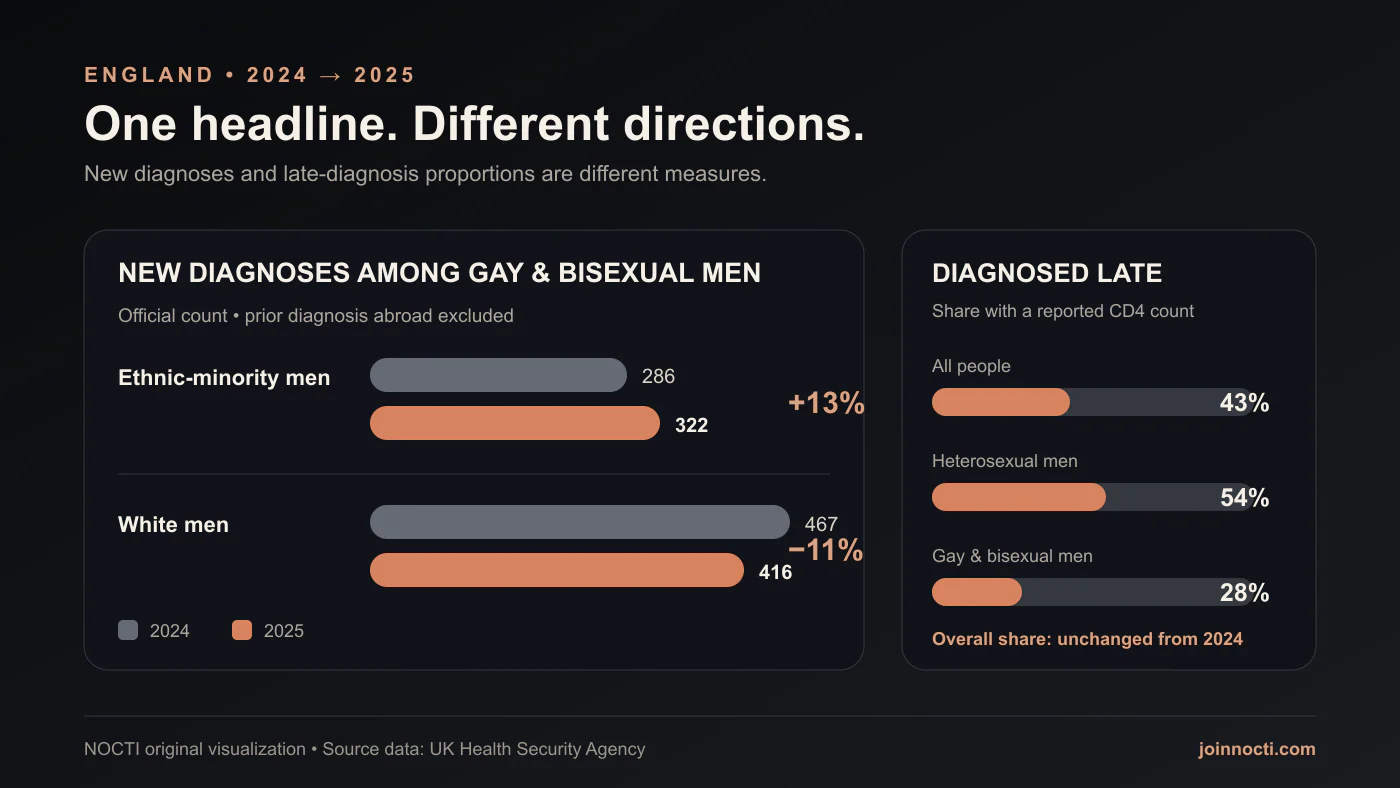
In 2025, 877 of 2,060 newly diagnosed people in England with a reported CD4 count met that late-diagnosis definition. The number fell 10% from 975, but the denominator also fell. The resulting proportion stayed at 43%—exactly where it was in 2024.
This is the denominator doing its quiet little accounting job. Fewer late diagnoses is good. An unchanged share says the system did not improve the timing of diagnosis across the eligible group.
Who moved in different directions?
England’s overall decline was not a universal decline. New diagnoses among adult ethnic-minority gay and bisexual men rose 13%, from 286 to 322. They increased both in London, from 146 to 165, and outside London, from 140 to 157.
Among White gay and bisexual men, diagnoses fell 11%, from 467 to 416. Late diagnoses also moved in opposite directions: they rose 14% among ethnic-minority gay and bisexual men, from 70 to 80, and fell 22% among White gay and bisexual men, from 130 to 102.
Those are counts, not explanations. The report does not support blaming a community, reading identity as behavior or assuming every increase is new transmission. It does support refusing to let one national percentage flatten different experiences.
| Measure | 2024 | 2025 | Change |
|---|---|---|---|
| New HIV diagnoses, United Kingdom | 3,117 | 2,823 | Down 9% |
| New HIV diagnoses, England | 2,789 | 2,604 | Down 7% |
| Ethnic-minority gay and bisexual men, England | 286 | 322 | Up 13% |
| White gay and bisexual men, England | 467 | 416 | Down 11% |
| Diagnosed late in England, share with a reported CD4 count | 43% | 43% | No change |
“New diagnoses” excludes people diagnosed before continuing care in England. The late-diagnosis share uses people with a CD4 count reported within 91 days and excludes evidence of recent infection.
Does a diagnosis trend equal a transmission trend?
Not automatically. UKHSA’s own dashboard says new-diagnosis trends can be affected by HIV transmission, testing activity, migration and reporting. A person can also live with HIV for years before symptoms appear, so the date of diagnosis is not necessarily the date of acquisition.
That gives us a credible competing explanation for any year-to-year change. More accessible testing can identify infections that would otherwise remain undiagnosed, temporarily lifting diagnosis counts even while prevention improves. Fewer tests can make a count look better while delaying care. Migration can also change who enters England’s surveillance and care systems.
NOCTI’s interpretation: use diagnosis data to locate unequal outcomes and service gaps, not to write a morality play about a population. The mechanism is access plus timing, not identity wearing a lab coat.
What does 43% “diagnosed late” mean?
It does not mean 43% of everyone living with HIV in England was untreated, or that 43% of tests were positive. It means 877 of the 2,060 newly diagnosed people included in this measure had a qualifying low CD4 count within 91 days, without evidence that the infection was recent.
The proportion was highest among heterosexual men at 54%, compared with 28% among gay and bisexual men. UKHSA also reported that adults diagnosed late in 2024 were four times more likely to die within a year than adults diagnosed promptly. That comparison describes groups in surveillance data; it cannot predict one person’s outcome.
The practical consequence is earlier access, not panic. A national statistic cannot tell you whether you have HIV or set your personal testing interval. An HIV test and a qualified service can.
What does the PrEP number show?
Among sexual-health-service attendees whom UKHSA classified as having a PrEP need, uptake reached 66% in 2025: 120,159 of 180,848 people. Uptake was 82% among both White and ethnic-minority gay and bisexual men.
That 82% is encouraging, but it does not prove equal access within every ethnic group, age, region or social circumstance. It includes people who reached a sexual health service and were recorded as having a PrEP need. People outside that pathway can disappear from the denominator before anyone gets to celebrate the percentage.
The apparent paradox—82% uptake alongside rising diagnoses in one group—is therefore not a contradiction. Prevention, testing, migration, service reach and the timing of infection all operate on different clocks. One measure cannot audit the whole system by itself.
Why does opt-out testing matter?
NHS England expanded blood-borne-virus opt-out testing in emergency departments from 2022. Across 78 first- and second-wave departments, 1,244 people were newly diagnosed with HIV from April 2022 through December 2025.
The share of new diagnoses found through that programme rose from 6% in 2022 to 16% in 2025. In other words, more diagnoses now come from a route that does not require someone to first decide that a specialist sexual health clinic is “for people like me.”
That mechanism matters for late diagnosis. Stigma, low perceived risk and ordinary healthcare friction can delay testing; an opt-out offer removes some of the identity and initiative burden. It is not proof that every emergency department offers the programme or that opt-out testing alone can close every gap.
What is known, inferred and still unknown?
Known: new UK diagnoses fell 9%; new England diagnoses fell 7%; the eligible late-diagnosis share stayed at 43%; and diagnosis trends differed by sex, exposure group and ethnicity.
Inferred: the tension between “diagnoses fell” and “late diagnosis did not improve” will confuse readers because both statements appear in the same release. Reddit and broader forum language repeatedly asks how often to test, whether PrEP replaces testing, what a late diagnosis means and whether a negative trend proves prevention is working. Those are qualitative question patterns, not representative polling.
Unknown: the report cannot identify one cause for the 13% increase among ethnic-minority gay and bisexual men, isolate transmission from testing and migration in every subgroup or predict 2026. X did not return a reliable current result set, so NOCTI is not claiming an X-wide consensus or a trending hashtag.
The strongest counterargument
A fair response is that the national direction really is good. New diagnoses fell, PrEP uptake rose, treatment coverage remained high and 98.2% of adults on treatment had suppressed viral loads. Overcorrecting toward the caveats can make progress sound imaginary.
The progress is real. So is the unevenness. A responsible reading does not swap optimism for doom; it asks who benefited, who did not and which denominator is doing the talking. National success and subgroup deterioration can coexist. Public health is annoyingly resistant to a single victory graphic.
The consequence is targeted action: preserve what is working, then extend testing and prevention beyond the people already easiest for services to reach.
A practical five-minute check
1. Separate “new diagnoses,” “all diagnoses” and “people accessing care.” They are not interchangeable totals.
2. Check the geography. PrEP and testing-service measures in this report are for England; the headline diagnosis count covers the UK.
3. Look for the denominator. The 43% late-diagnosis figure covers people with a reported CD4 count who meet the surveillance definition.
4. Do not turn a group trend into an individual risk score. Testing history, exposure, prevention and clinical context belong in a private conversation with a qualified service.
5. In England, NHS sexual health clinics offer free, confidential HIV testing, PrEP and PEP. Use the official clinic finder rather than guessing which service is available locally.
6. If you think you may have been exposed to HIV within the last 72 hours, NHS says PEP assessment is time-sensitive; contact a sexual health clinic or A&E now.
Frequently asked questions
Did HIV diagnoses fall in the UK in 2025? Yes. UKHSA recorded 2,823 new diagnoses, 9% fewer than in 2024.
Why did the late-diagnosis percentage stay at 43%? The number diagnosed late fell, but so did the eligible number of newly diagnosed people with a reported CD4 count. The proportion therefore stayed unchanged.
Does “late diagnosis” mean AIDS? Not necessarily. UKHSA’s surveillance definition uses a CD4 count below 350 within 91 days while excluding evidence of recent infection. It is not the same label as an individual diagnosis of AIDS.
Are diagnoses rising among gay and bisexual men? Overall diagnoses among gay and bisexual men in England fell 4%, but they rose 13% among ethnic-minority gay and bisexual men and fell 11% among White gay and bisexual men.
Does PrEP remove the need for testing? No. NHS requires HIV and other STI testing before PrEP and continued monitoring while taking it; a clinic can advise on the right schedule and method.
What hashtags fit the social package? NOCTI is using #HIVTesting, #PrEP, #GayMensHealth, #WorldAIDSDay and #NOCTI as descriptive labels. This is editorial judgment, not a claim that they are trending.
Editorial note
This article was checked on November 26, 2026 against UKHSA’s 2026 HIV report, official quality-and-methodology notes and dashboard definitions, plus the current NHS sexual-health-clinic and HIV guidance. It reports population statistics and official service routes; it does not diagnose an individual, set a personal testing schedule or claim that one factor caused a group trend.
The two images are original NOCTI data visualizations based on UKHSA official statistics. They contain no patient, clinician, model, provider, medical record or clinical result and are not evidence about an individual.
Source: UK Health Security Agency and NHS, edited by NOCTI.
Republishing: please credit NOCTI (joinnocti.com).
Use the statistic as a prompt, not a diagnosis.
NHS sexual health clinics are free and confidential and offer HIV testing, PrEP and PEP. If you think you may have been exposed to HIV in the last 72 hours, NHS says to seek PEP assessment through a sexual health clinic or A&E now.
Find an NHS sexual health clinic