Men’s Sports Massage & Recovery Guide
Sports massage after a workout: five ways men can use it safely
Sports massage may modestly ease delayed-onset muscle soreness and improve flexibility, but research does not show a direct boost in strength, sprinting, endurance or jumping. These five evidence checks help men decide when it fits—and when pain belongs with a clinician.
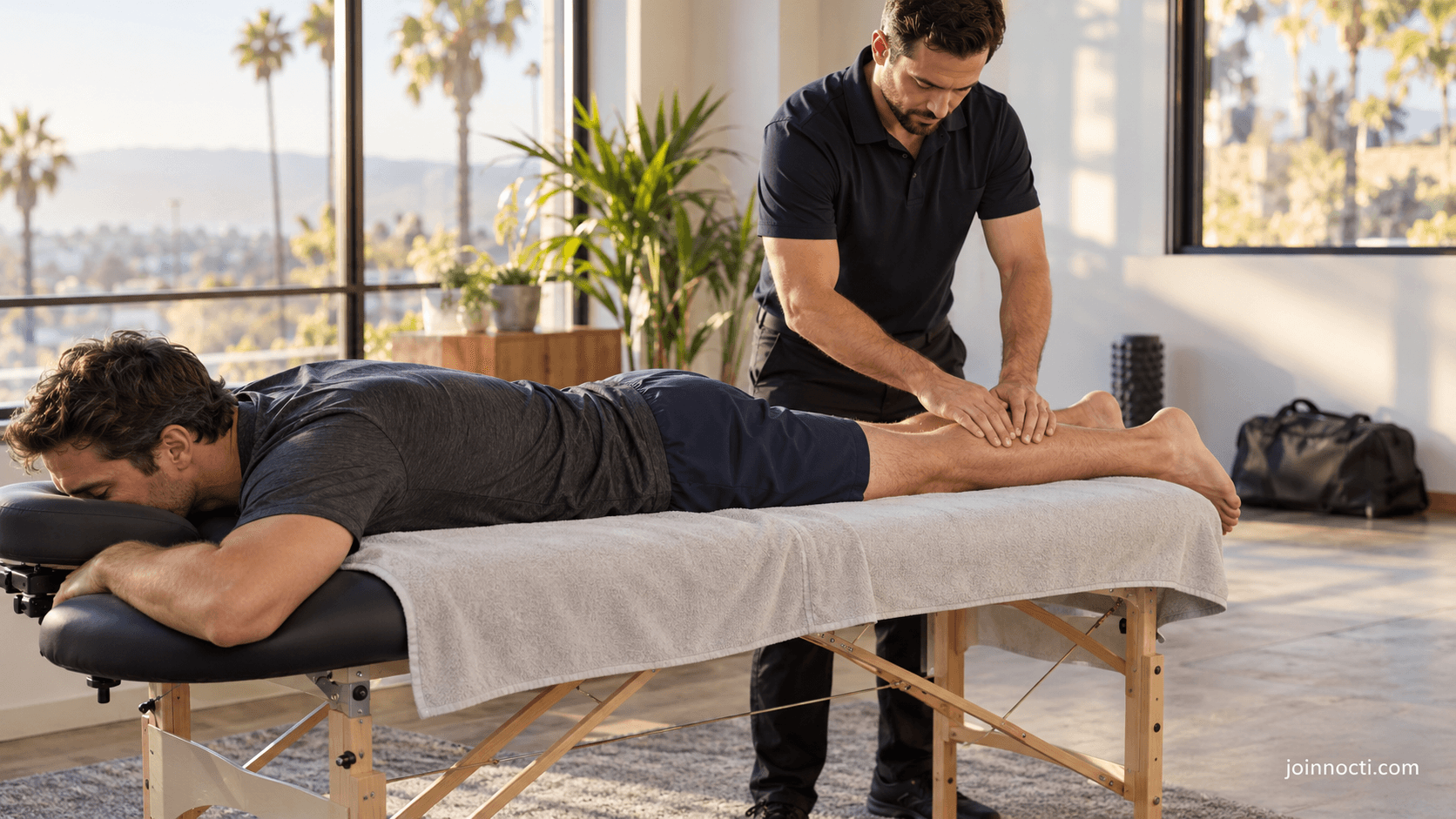
What sports massage can—and cannot—do after a workout
“Sports massage” describes massage adapted to a training or competition goal; it is not one standardized dose or a promise of faster healing. A 2020 systematic review of 29 randomized studies involving 1,012 participants found no evidence that sports massage directly improved strength, jump, sprint, endurance or fatigue measures. It did find small improvements in flexibility and delayed-onset muscle soreness. A 2026 network meta-analysis likewise found that massage may help early soreness after exercise, while effects on explosive performance and laboratory markers were limited or faded with time. That makes sports massage a possible comfort and recovery preference—not a performance shortcut, injury treatment or substitute for a training plan.
Who this guide is for—and the decision it helps with
This guide is for adult men considering massage around recreational training, a race, league play or a return to an ordinary workout routine. It helps separate three decisions: whether the goal is comfort or performance, whether the sensation looks like expected post-exercise soreness or a possible injury, and whether a specific provider can work safely within scope. It does not diagnose pain or clear anyone to train. Competitive athletes should also follow their team clinician, athletic trainer, coach and sport rules when those apply.
1. Name the goal and timing before choosing the session
Tell the therapist what you did, when you did it and what you want from the appointment. “My calves feel generally sore the day after a new hill workout” is more useful than asking for the deepest sports massage available. If the goal is to sprint, lift or compete immediately afterward, know that the research does not show a reliable direct performance gain and that longer pre-performance massage has sometimes been associated with reduced short-term strength or power. For post-workout comfort, ask what areas, pressure range, session length and technique the therapist proposes—and how those choices match the goal.
2. Separate ordinary soreness from a possible injury or clot
Delayed-onset muscle soreness usually follows unfamiliar or unusually hard exercise and can build over the next day or two, but a client should not use that label to explain every symptom. The National Institute of Arthritis and Musculoskeletal and Skin Diseases lists sudden severe pain, extreme swelling or bruising, inability to bear weight or move a joint normally, extreme weakness and an obvious deformity as signs of an acute sports injury. New one-sided swelling, pain or tenderness, warmth, or red or discolored skin can also be signs of a blood clot, according to CDC. Cancel the massage and seek appropriate medical care for those findings; call 911 for difficulty breathing, chest pain, coughing blood, fainting or another emergency.
3. Verify the provider’s scope and sports experience
Ask what training the therapist has with post-exercise sessions, which body areas and techniques are within scope, and how the therapist responds when a symptom sounds clinical. In California, check the credential actually claimed: CAMTC offers voluntary statewide certification, while cities and counties may regulate establishments or practitioners who are not CAMTC certified. A public CAMTC lookup can verify a claimed certificate; it cannot prove that one therapist is the right fit for a sport or diagnose an injury. Compare the therapist’s explanation, current credential or permit, boundaries, total price and cancellation policy—not physique, profile photos or “elite recovery” marketing.
4. Share the health facts that can change pressure or timing
Before hands-on work, disclose a recent injury or surgery, fracture risk, numbness, skin wound or infection, unusual swelling, bleeding disorder, blood-thinning medicine, cancer treatment, pregnancy or another condition that could change the plan. NIH’s National Center for Complementary and Integrative Health says serious harms appear uncommon, but rare blood clots, nerve injuries and fractures have been reported, particularly with vigorous massage or in people at higher risk. Forceful pressure is not evidence of a better session. Agree on areas to avoid and pressure language before starting, and say “lighter,” “stop” or “skip that area” at any point.
5. Judge the result by the original goal—not a recovery claim
Afterward, record the result that mattered: soreness during ordinary movement, comfort, flexibility, sleep or readiness for the next planned activity. Notice what happens over the next 24 to 72 hours rather than treating a temporary sensation as proof of tissue repair. Do not accept claims that massage flushes toxins, prevents injury, heals a tear or guarantees faster performance. There is no universal session frequency for every athlete; training load, sleep, food, hydration, cost, health history and clinician guidance may matter more. If pain worsens, function falls, numbness or weakness appears, or swelling develops, stop rebooking and seek an appropriate evaluation.
What should happen next—and the most reliable place to start
Start with the symptom and goal, then use the evidence to set a modest expectation. NIH NCCIH is the most reliable first stop for general massage safety; NIAMS explains sports-injury warning signs, and CDC covers blood-clot symptoms. For a routine session, verify the provider’s claimed credential and ask for a clear plan before paying. NOCTI can help compare published provider details and location, but providers are independent and a listing is not medical clearance, a credential guarantee or proof that sports massage will improve performance.
Sources
- Google Trends: U.S. Web Search comparison for “sports massage,” “massage after workout” and “post workout massage,” past 12 months, retrieved September 30, 2026 ↗
- PubMed: 2026 systematic review and network meta-analysis of post-exercise recovery strategies ↗
- PubMed: 2020 systematic review and meta-analysis of sports massage, performance and recovery ↗
- PubMed: 2023 systematic review of massage and sport or exercise performance ↗
- PubMed: systematic review of pre-performance massage and strength or functional performance ↗
- NIH National Center for Complementary and Integrative Health: massage evidence, safety and provider questions ↗
- NIH National Institute of Arthritis and Musculoskeletal and Skin Diseases: sports-injury symptoms and care boundaries ↗
- CDC: signs and symptoms of deep vein thrombosis and pulmonary embolism ↗
- California Massage Therapy Council: consumer certificate verification and complaint information ↗
- California Massage Therapy Council: voluntary certification and local-regulation FAQs ↗
Find men’s massage near you
Compare local providers privately and contact the professional you choose directly.
Search NOCTI