HEALTH / Sleep & Respiratory Devices
Luna G3 BPAP Recall: Which Machines Need the Firmware Fix?
A Class I recall covers certain Luna G3 BPAP model LG3800-30VT devices when Targeted VT is enabled. Here is how to check the model and serial number, why old pressure reports may be wrong and why patients should not change therapy on their own.
The short answer
The Class I recall covers certain Luna G3 BPAP model LG3800-30VT devices using Targeted VT, not every Luna or PAP machine. Keep prescribed therapy unchanged until a clinician or DME supplier guides you; match the serial number and arrange firmware G3-2.00.80. Historical pressure reports may remain wrong after the update.
What exactly is under recall?
The U.S. Food and Drug Administration classified the action as a Class I recall and posted its enforcement record on November 12, 2026. React Health, doing business as 3B Medical, issued an updated patient and provider notice on November 17; FDA posted that company announcement on November 19.
The affected product is the Luna G3 BPAP System, model LG3800-30VT, UDI-DI 06948538365731, distributed in the United States and Puerto Rico. The official notice links a long Appendix A of affected serial numbers. A Luna logo, a similar case shape or the letters “PAP” do not establish that a machine is included.
| Check | Current BPAP recall | Why it matters |
|---|---|---|
| Product | Luna G3 BPAP System | The brand family alone is not specific enough. |
| Model | LG3800-30VT | Other Luna, CPAP, APAP and BPAP models are not automatically included. |
| Feature | Targeted VT enabled | The reporting error described by the firm occurs when this feature is on. |
| Serial number | Must appear in the official Appendix A | The serial list, not a headline unit count, identifies an affected machine. |
| Correction | Firmware G3-2.00.80 through React Health or the DME supplier | The update fixes future reporting; it does not rewrite old pressure data. |
Patients should not change prescribed settings or stop respiratory therapy on their own. The clinician or DME supplier coordinates the device-specific correction and any therapy transition.
What went wrong with Targeted VT?
Targeted VT is a clinician-set mode designed to adjust pressure within prescribed limits to support a target tidal volume. In affected machines, the reporting path can store and transmit the configured inspiratory pressure instead of the pressure actually delivered. The internal SD card and React Health Connect report can therefore show the wrong historical pressure statistics.
That distinction is the mechanism. The recall is not simply saying that every affected machine always delivered the wrong pressure. It says the record used to review therapy can be inaccurate. A clinician relying on that record could misread performance, change settings from bad data or miss a chance to optimize therapy. The chart can be wrong even when the machine on the nightstand looks perfectly calm.

Why do two official records show different device counts?
FDA's enforcement database lists 12,672 units in commerce. The later company announcement says 7,533 affected devices were distributed. Both are official public records, and neither page explains the difference.
A plausible explanation is that the numbers use different scopes or were updated at different points in the correction, but that is an inference—not a fact NOCTI can settle from the published material. The practical consequence is refreshingly unglamorous: do not use either total to decide whether your machine is affected. Match model LG3800-30VT and the individual serial number in Appendix A.
What should a patient do now?
React Health's patient instructions say to contact the prescribing clinician and/or durable medical equipment supplier promptly. Patients should not independently change prescribed settings or discontinue respiratory therapy. The notice says to continue using the Luna G3 BPAP as prescribed until the healthcare provider gives additional guidance.
The correction runs through the provider or DME supplier. React Health asks affected customers to return the recall response form and says it will provide firmware G3-2.00.80 on an SD card. A DME supplier can confirm the serial number, arrange the update and coordinate an unaffected PAP device if a clinician determines that a therapy transition is needed.
What happens to old pressure reports after the firmware update?
The firmware correction allows the device to collect and display reported pressure data while Targeted VT is enabled going forward. React Health says the update does not change historical records already collected under the faulty behavior. Those older reports can continue to show non-fluctuating pressure values in device storage and the cloud platform.
That means “updated” and “historically clean” are not the same status. Ask the clinician which dates may contain unreliable pressure data, whether symptoms or other measures require reassessment and how the updated device will be checked. Do not erase data unless the recall instructions and the team managing the device tell you to do so.
How serious is the reported problem?
React Health says it received 15 complaints and two serious adverse-event reports associated with the Targeted VT issue as of the November 17 update. “Associated” does not prove that the reporting error caused each event, and the announcement does not describe the two reports in enough detail to estimate an individual patient's risk.
The strongest limiting explanation is that built-in controls still keep delivered pressure within clinician-defined minimum and maximum settings while targeting the prescribed tidal volume. That may reduce risk. It does not make inaccurate historical reporting harmless, because clinical decisions can depend on those reports. The Class I label describes the potential for serious harm; it is not proof that every machine failed or every user was injured.
Is this the same Luna G3 recall NOCTI covered in September?
No. The September article concerns Luna G3 APAP model LG3600 with firmware G3-2.00.76, where unusual operating conditions could trigger an error and shut the machine down. That event uses a different model, firmware path, failure mechanism and correction.
The current BPAP recall concerns model LG3800-30VT and inaccurate Targeted VT pressure reporting. Search results can put both stories under the same “Luna G3 recall” umbrella. The historical comparison is exactly why model numbers matter: one family name, two very different questions.
What is known, inferred and still unknown?
Known: FDA lists this as an open Class I recall for Luna G3 BPAP model LG3800-30VT. The reporting issue appears when Targeted VT is enabled. The official records identify the serial list, firmware G3-2.00.80, 15 complaints, two serious reports and instructions not to change or stop prescribed therapy without professional guidance.
Inferred: the 12,672-versus-7,533 count difference probably reflects different scopes, timing or record definitions. The public pages do not confirm which explanation is correct, so the serial-number appendix remains the reliable device-level test.
Unknown: the published records do not resolve the count discrepancy, provide a patient-by-patient causal analysis, say how many devices still await correction or guarantee that a particular user's historical reports are clinically unimportant.
Six questions to take to your DME supplier or clinician
1. Is my machine exactly model LG3800-30VT?
2. Does its serial number appear in the current Appendix A?
3. Is Targeted VT enabled on my prescribed setup?
4. Which dates of SD-card or cloud pressure data may be unreliable?
5. Who will install and confirm firmware G3-2.00.80, and how will that confirmation be documented?
6. Do I need an unaffected replacement during the correction, and who will coordinate it?
Frequently asked questions
Should I stop using my Luna G3 BPAP tonight? The company notice says to continue prescribed therapy until your clinician or DME supplier gives additional guidance. Do not change settings or stop treatment on your own.
Is every Luna G3 machine recalled? No. This action identifies model LG3800-30VT, Targeted VT use and specific serial numbers.
Does the machine necessarily deliver the wrong pressure? The published defect concerns what pressure is recorded and transmitted. The firm says design controls still adjust delivery within clinician-set limits, but inaccurate reports can still affect decisions.
Will the firmware fix old reports? No. React Health says firmware G3-2.00.80 fixes future reporting; previously stored data remain unchanged.
Why do the official unit counts differ? FDA's enforcement record lists 12,672 units in commerce; the later company announcement says 7,533 devices distributed. The public records do not explain the mismatch, so use the serial-number list.
Editorial and image note
This article was checked against FDA's Class I enforcement record, FDA's November 19 posting of the React Health update, the manufacturer's current correction page and the device's FDA clearance record. A current Reddit thread and public search results repeatedly centered on whether the notice was a new recall, how to find affected serial numbers and whether users should stop therapy. X did not return a reliable current discussion set, so no trending or representative-opinion claim is made.
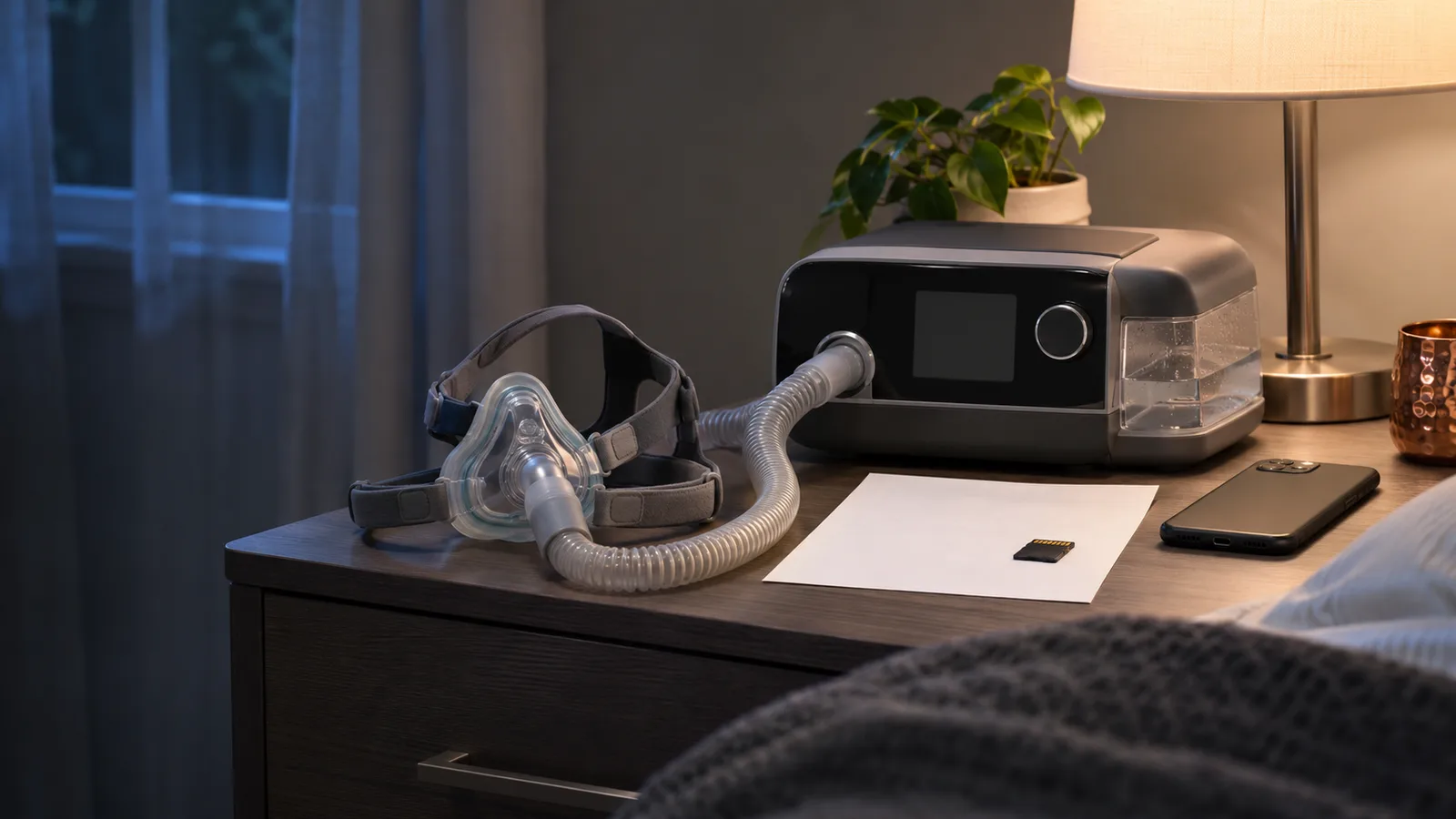
The two original AI-generated NOCTI images are people-free editorial illustrations. They show generic, unbranded equipment and abstract records—not a Luna G3 BPAP, an affected serial number, a real patient's data or proof of the defect.
Source
Source: U.S. Food and Drug Administration and React Health, edited by NOCTI.
Republishing: please credit NOCTI (joinnocti.com).
Match the model, feature and serial number.
If you use a Luna G3 BPAP, ask your clinician or durable medical equipment supplier whether it is model LG3800-30VT, whether Targeted VT is enabled and whether the serial number appears in the official appendix. Keep prescribed therapy unchanged until they guide the correction.
Read the current FDA-posted notice