MOVE / Exercise Habits & Public Data
One in Four EU Adults Reported No Leisure Exercise. What Does That Mean?
A new OECD and European Commission report says 26% of EU adults reported no moderate-intensity leisure activity in a typical week. The catch matters: the survey measured frequency, not minutes or effort, so it cannot tell who met the 150-minute guideline.
The quick answer: this is a frequency snapshot
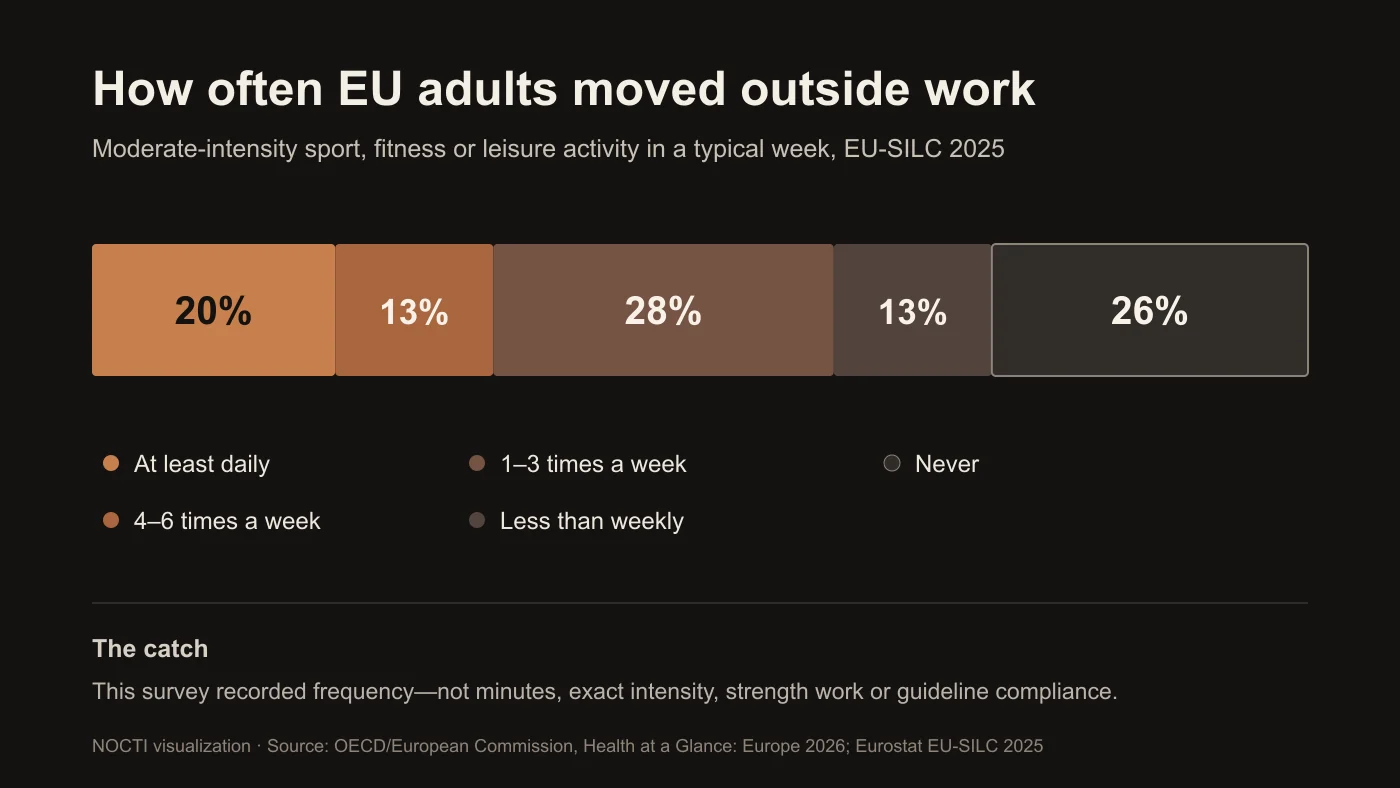
The new OECD/European Commission report says 26% of EU adults reported no moderate-intensity leisure activity in a typical 2025 week, while 33% were active daily or four to six times. That is a frequency snapshot—not proof that one group met or missed the 150-minute guideline—because the survey did not measure duration or intensity.
What did the 2025 EU survey actually measure?
Health at a Glance: Europe 2026 uses the European Union Statistics on Income and Living Conditions survey, or EU-SILC. Adults were asked how often they did moderate-intensity physical activity outside work in a typical week. The activity could include sport, fitness or recreational movement.
The EU-wide breakdown was 20% at least once a day, 13% four to six times a week, 28% one to three times a week, 13% less than once a week and 26% never. OECD and the European Commission published the report on November 25, using 2025 survey data that Eurostat had made available by July 2026.
That calendar matters. This is newly published analysis of last year's answers, not a live counter of what people did this morning.
Did men do better than women?
A little, on this one measure. Across the EU, 34% of men and 32% of women reported activity either daily or four to six times per week. The report says the gap was larger among people ages 16 to 24 and those over 75.
Two percentage points is not permission to turn the result into a masculinity trophy. The survey does not say how long those sessions lasted, how hard they were, whether strength work happened or whether the difference reflects access, work, caregiving, health, culture or reporting.
The published breakdown also does not identify gay, bisexual or transgender respondents. NOCTI cannot honestly convert a men-versus-women average into a claim about LGBTQ+ adults. The useful question is what the measure reveals—and what it leaves backstage in sweatpants.
Does “never” mean completely sedentary?
No. In this indicator, “never” means the respondent reported no moderate-intensity physical activity outside work in a typical week. It does not prove zero movement all day.
Someone with a physically demanding job could fall into the “never” leisure category. Someone who trained once for five minutes and someone who trained once for 90 minutes could both land in the same one-to-three-times bucket. Ordinary light movement may also fail the moderate-intensity threshold even though it is still movement.
That limitation does not make the 26% figure meaningless. It makes the figure narrower: a quarter of EU adults reported no moderate leisure activity, which suggests a large participation gap. It does not diagnose the reason, calculate total energy use or tell us that every person needs the same gym prescription.
| Measure | What it captures | What it cannot establish |
|---|---|---|
| EU-SILC 2025 frequency | How often adults reported moderate-intensity, non-work activity in a typical week | Minutes, exact effort, strength training or WHO-guideline compliance |
| 2019 duration measure cited by the report | Whether adults reported at least 150 minutes of activity per week | A current 2025 trend using the same survey question |
| Current U.S. adult guideline | 150 moderate minutes, 75 vigorous minutes or a mix, plus strength work on two days | A diagnosis, fitness score or pass/fail verdict on one individual |
Frequency, duration and intensity are related, but they are not interchangeable. A neat headline does not get to merge the columns.
Can the report tell who met the 150-minute target?
No. The report says so directly: this frequency indicator does not capture duration or exact intensity and therefore cannot assess compliance with World Health Organization recommendations.
The same chapter notes that a different 2019 survey found slightly less than one-third of adults met the recommendation of at least 150 minutes per week. That older result measured a different thing with a different survey. Putting the two percentages side by side can provide context, but subtracting one from the other and calling it a trend would be statistical cosplay.
For U.S. readers, CDC currently recommends at least 150 minutes of moderate aerobic activity per week, 75 minutes of vigorous activity or an equivalent mix, plus muscle-strengthening activity on two days. CDC also says the minutes can be broken into smaller chunks and that any amount of moderate or vigorous activity provides some benefit.
Why frequency still matters
Frequency can reveal whether movement has a regular place in ordinary life. Repeating an activity lowers the restart cost: shoes are easier to find, the route is familiar, and the plan asks less negotiation from a tired brain. That is a plausible behavior mechanism, not something this survey tested.
The report also finds a middle-age dip in frequent activity, with rates rising somewhat at ages 65 to 74 before falling again after 75. Time pressure, health, access, retirement and local infrastructure could all contribute. The cross-sectional survey cannot tell which mechanism caused the age pattern.
A competing explanation is measurement. People in different countries or life stages may interpret “moderate,” “physical activity” and a “typical week” differently. Self-reports can misremember or round behavior. Country differences may reflect real environments and customs, different reporting habits or both. Denmark, Finland and the Netherlands ranked highest; Bulgaria and Croatia ranked lowest. The chart describes the pattern. It does not put national character on trial.
Does walking count—and what does moderate feel like?
Walking can count when it reaches moderate intensity for the person doing it. CDC describes moderate activity as effort that raises breathing and heart rate; brisk walking is its standard example. A practical talk test is whether you can talk but not sing. Vigorous work makes speaking more than a few words difficult.
Current public questions show why the distinction trips people up. Reddit users repeatedly ask whether walking counts, whether Zone 2 is required, whether lifting covers cardio and whether 150 minutes must happen in long sessions. Those threads are useful language evidence, not medical consensus or representative polling.
You do not need a premium watch to earn citizenship in the land of movement. Heart-rate zones can be useful, but age formulas and wearables estimate. For a beginner, a repeatable brisk walk, bike ride, swim, dance class or adapted activity can be a cleaner start than chasing a gadget's colored ring.
A practical weekly check
1. Write down your aerobic minutes for one ordinary week, not your most heroic week.
2. Mark moderate effort with the talk-but-not-sing test and vigorous effort with the few-words test.
3. Count strength work separately. CDC's adult guideline includes two days that work the major muscle groups.
4. Look for the friction point: time, pain, transport, cost, confidence, equipment, safety or a plan that is simply boring.
5. Change one constraint before adding a grand ambition. Ten useful minutes near home can beat a 90-minute fantasy across town.
6. If you have a chronic condition, disability, new exertional symptoms or have been inactive and want to start vigorous exercise, ask a healthcare professional what type and progression fit your situation.
The goal is not to win a survey category. It is to build enough movement that your actual week—not your motivational wallpaper—can carry it.
What is known, inferred and still unknown?
Known: In EU-SILC 2025, 26% of EU adults reported never doing moderate-intensity physical activity outside work in a typical week; 33% reported doing it daily or four to six times weekly; and the frequent-activity share was 34% among men and 32% among women.
Inferred: A large leisure-activity participation gap likely reflects more than personal motivation. Time, health, cost, transport, safe space, social comfort and local design are credible mechanisms, but this indicator does not rank them.
Unknown: Session duration and exact intensity, strength training, total work-related movement, objective device measurements, causal reasons for country or gender differences, individual fitness and the activity pattern of LGBTQ+ adults. The report gives a wide map, not everyone's route home.
Frequently asked questions
Did 26% of EU adults get no exercise at all? The indicator says they reported no moderate-intensity physical activity outside work in a typical week. It does not measure every movement at work or home.
Did 33% meet the exercise guideline? Not necessarily. They reported frequent activity, but the survey did not record enough duration or intensity detail to test the 150-minute recommendation.
Were men much more active? Men were two percentage points higher on the frequent-activity measure, 34% versus 32%. The average does not explain the cause or describe every man.
Does walking count? Brisk walking can count as moderate activity. Effort is relative; the talk test is a practical check.
Do I need 150 minutes in one session? No. CDC says adults can spread the total across the week and break it into smaller chunks.
Is 150 minutes a magic pass/fail line? It is a public-health target, not a diagnosis or moral score. Some activity is better than none, and sustainable progression matters.
Editorial and image note
This article reports OECD, European Commission, Eurostat and CDC records. It separates the new frequency indicator from a duration-based guideline and does not claim that country differences are caused by motivation, policy or culture.
Current Reddit questions centered on whether walking counts, what moderate and vigorous mean, whether Zone 2 is mandatory, whether lifting replaces aerobic work and how to fit 150 minutes into a real week. X did not return a reliable current result set. These signals shaped the questions and wording only; they are not search-volume estimates, representative polling or proof that a hashtag is trending.
The hero is an original, people-free AI editorial still life. The inline chart is an original NOCTI visualization of the published EU-wide percentages. Neither image depicts survey participants, a real gym, an exercise outcome or OECD evidence collection.
Source
Source: OECD, European Commission, Eurostat and U.S. Centers for Disease Control and Prevention, edited by NOCTI.
Republishing: please credit NOCTI (joinnocti.com).
Count the work you can repeat—not a perfect week you cannot.
For U.S. adults, CDC says the weekly target is 150 minutes of moderate aerobic activity, 75 minutes of vigorous activity or an equivalent mix, plus muscle-strengthening work on two days. The minutes can be split into smaller chunks, and some activity is better than none.
See what CDC counts as physical activity