Move Journal / Training
Good coaching. Beyond the physique.
A strong body can catch your eye. Choosing a coach takes a closer conversation—about your goals, their skills and the work between appointments.
- Match the coach to the goal you actually have.
- Check credentials, communication and the plan for progress.
- Session prices, trainer pay and business profit are different numbers.

Someone can be very good at training their own body and still have more to learn about coaching yours. Someone else can be an excellent coach without looking like the person in a fitness advertisement. Neither a photograph nor a follower count settles the question.
For a client, the practical task is finding suitable help. For an independent trainer, it is making that help understandable and discoverable. Both start with a more specific question than “Who looks the most impressive?”
What are you hiring a trainer to do?
You might want to learn unfamiliar equipment, build strength for everyday activities, return to a consistent routine or prepare for a recreational sport. You may want a private setting or a coach who makes the gym feel less intimidating. Those are different briefs, and they deserve different conversations.
Ask a prospective trainer to explain how they would begin with your goal. Listen for questions about your experience, available time, equipment and relevant limitations. Ask how they would make a session easier, harder or more manageable when life changes.
A six-pack can be part of someone’s personal training story. It cannot show you whether they can teach clearly, listen carefully, recognize their limits or adjust a plan to another person. Equally, a popular online coach may be highly competent. Popularity and competence need to be assessed separately.
The appearance pressure is real enough to discuss.
In one public r/personaltraining thread, an aspiring trainer worried about finding clients without the expected physique. Responses described different preferences: some emphasized visible fitness, while others valued relatability, trust and coaching ability. The disagreement matters more than any single comment.
This is a self-selected conversation, not a representative survey of what clients buy. It cannot tell us how many trainers lose work because of appearance, or prove that followers never help. It does show why “just look the part” is an incomplete answer to someone trying to build a practice.
The client still needs evidence they can use: a clear service description, relevant education, a sensible first-session plan and an explanation of how progress will be assessed. Those are things a trainer can communicate without promising a body transformation.
Fitness goals reach well beyond appearance.
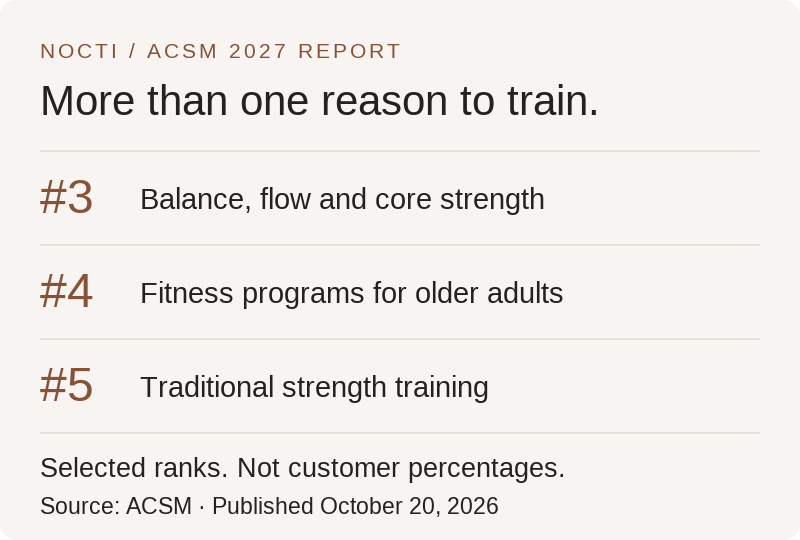
ACSM ranked programs for older adults second in its 2026 fitness trends report. Its next report, published October 20, 2026 for 2027, placed balance, flow and core strength third, older-adult programs fourth and traditional strength training fifth.
These are industry trend rankings, not percentages of customers, local demand estimates or a forecast of anyone’s bookings. They point to several kinds of expertise worth discussing; they do not tell every trainer to sell the same service.
A useful editorial conclusion is that “getting fit” needs a more precise definition. Carrying groceries, feeling capable on the gym floor and preparing for a race can all motivate someone to seek help. A goal does not have to photograph well to matter.
Open full-size graphic ↗
Start with the person, then choose the format.
The examples below are a way to organize a consultation, not a ranking of the largest markets. A person can belong in several rows. Age, gender and appearance do not replace a conversation about capability and preference.
Online coaching can suit someone who wants flexible programming and feedback. In-person sessions can suit someone who wants observation and guidance as they practice. A prerecorded workout, a live class and individually adjusted coaching are different services; ask which one the price actually includes.
| Your starting point | What to ask about |
|---|---|
| New to the gym | Patient instruction, equipment setup and a manageable first session. |
| Everyday strength | Progression around practical goals rather than appearance alone. |
| Active aging | Experience adapting strength, balance and movement to individual ability. |
| Recreational sport | Relevant conditioning experience and realistic training demands. |
| Busy or traveling | A plan that works with available time, equipment and feedback. |
| Privacy or personal comfort | Studio, home or online arrangements and respectful communication. |
| Social motivation | Group size, supervision and whether the pace can be adjusted. |
Active aging deserves specific skills.
CDC’s guidance for adults 65 and older combines aerobic activity, muscle strengthening on at least two days a week and balance activities. The aerobic target is at least 150 minutes of moderate activity, 75 minutes of vigorous activity or an equivalent mix. Ability and health conditions matter; some activity is better than none.
That is general guidance, not a ready-made workout for every older client. Ask a coach how they adapt the starting point and respond to relevant medical advice. A birthday alone cannot tell them which exercises, loads or pace are appropriate.
A trainer’s role is not to diagnose symptoms, treat an injury or replace rehabilitation. If a health condition or new symptom raises a concern, the plan may need input from a qualified healthcare professional. Referral can be part of responsible coaching.
Read the credential, not just the initials.
Ask for the exact credential, issuing organization and current status. A professional certification is different from a government license; one label should not be substituted for the other. Check local requirements for the service rather than assuming a certification authorizes every activity.
ACE, for example, distinguishes its non-accredited personal training certificate from its NCCA-accredited Certified Personal Trainer certification. Its current eligibility information includes CPR/AED training with a live skills check. Those details are more informative than a profile that simply says “certified.”
Credentials provide a starting point, not a guarantee of fit. Ask about experience with your goals, communication and what happens when a request is outside the trainer’s scope. Online delivery does not make those questions disappear.
The session price is not the trainer’s take-home pay.
BLS reports a U.S. median annual wage of $47,160 for fitness trainers and instructors in May 2025. It projects 7% employment growth from 2025 to 2035 and roughly 68,000 openings per year, including replacements for people leaving the occupation. Its wage statistics exclude self-employed workers.
Those figures describe an occupation, not a typical independent trainer’s profit or a particular gym’s pay policy. A growing field can still contain people with empty calendars. Local prices, unpaid work and the cost of finding clients affect the picture.
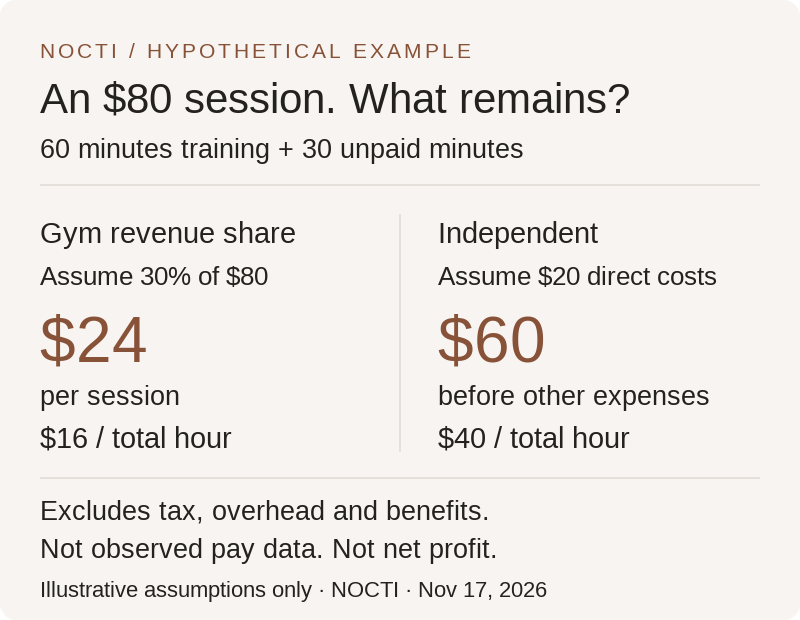
Consider an explicitly hypothetical $80, 60-minute session. At a 30% revenue share, a gym trainer would receive $24. An independent trainer charging the same amount with $20 in direct costs would have $60 left before other expenses. Add 30 minutes of unpaid preparation or administration, and those amounts become $16 and $40 per total hour respectively.
This example is not an estimate of actual chain-gym pay, employment rights or net earnings. It excludes taxes, insurance, education, marketing, fixed costs and any employee benefits. An employer may provide equipment, leads or paid time; an independent trainer may carry those costs. Compare the full agreement rather than the headline percentage.
Open full-size graphic ↗
For trainers: make your specialty easy to find.
A practical starting point is a service you can describe without a superlative: patient first-gym sessions, strength coaching for daily life, or private training in a specific service area. Explain who it suits, how you begin, what it costs and where your expertise ends.
Local discovery, referrals and community relationships are options to test. They are not guaranteed sources of clients. A clear profile helps someone assess fit; a thoughtful first conversation helps them decide whether to book. Neither requires mass messages to strangers.
Track the stages separately: qualified inquiries, consultations, first sessions, repeat sessions and referrals. Ten inquiries that never become a conversation suggest a different problem from ten first sessions with no returns. Avoid treating every quiet week as proof that your appearance is the obstacle.
Ask for feedback without pressure. Use client images or testimonials only with permission, and do not make promised outcomes more dramatic than the service can support. A smaller, well-matched client base can be a more useful objective than a large audience with little interest in booking.
Make the first conversation count.
Before buying a large package, understand the session length, total price, cancellation terms and what support is included between appointments. Ask whether a consultation or single session is available. A good explanation should leave you better informed even if you decide not to buy.
For NOCTI readers, the useful comparison is among services and people who match a real need. A directory listing is a starting point for checking details with a provider; it is not a promise of clinical outcomes, verified credentials or an available appointment.
A coach does not need to become an influencer to have something valuable to offer. A client does not need to pursue a particular physique to deserve careful instruction. What matters next is whether the two can agree on a realistic plan.
- What experience do you have with goals like mine?
- How will we choose a starting point and track progress?
- Where can I check your credential and current status?
- What happens if an exercise or plan does not suit me?
- What will I pay, and what does that include?
A few useful answers.
Does a personal trainer need to look like a fitness model?
Appearance alone cannot establish teaching ability or suitability. Assess relevant credentials, communication, experience and how the proposed plan fits your goals.
Is online coaching the same as buying a workout video?
Not necessarily. Ask whether the service includes live instruction, individual programming, technique feedback or adjustments. A prerecorded plan may include none of those.
Can a trainer treat my injury?
A personal training credential does not itself authorize injury treatment or diagnosis. Ask an appropriately qualified healthcare professional about symptoms or rehabilitation needs.
Does the $80 example show what trainers actually earn?
No. It demonstrates arithmetic using invented inputs. It is neither a gym pay survey nor a calculation of after-tax profit.
About this article
An editorial review checked November 17, 2026, not a new labor-market survey, financial forecast, legal opinion or individual exercise prescription. No clinician review of this NOCTI article is claimed.
Public comments illustrate questions, not prevalence. The client groups and business suggestions are editorial frameworks. The financial graphic is explicitly hypothetical. No chain-specific pay claim, booking uplift or NOCTI matching algorithm is presented as established fact.
The original NOCTI illustrations are not before-and-after evidence or testimonials. No third-party commercial gym photographs or private client information have been reproduced.
Sources (7)Read moreRead less
- Reddit — Body comp matters when getting clients, right?
A public discussion of appearance and client trust. Self-selected accounts, not a representative industry survey; personal identifiers and body measurements are not reproduced.
- ACSM — Top fitness trends for 2026
Professional trend report: older-adult programs ranked second. Rankings are not customer percentages or local market size.
- ACSM — 2027 fitness trends, October 20, 2026
Published ahead of 2027. The graphic selects ranks 3, 4 and 5 from this report; it is not labeled as 2026 demand data.
- CDC — Older adult activity: An overview
General activity guidance, updated December 4, 2025; not an individualized exercise prescription.
- ACE — Personal trainer certification and eligibility
Current distinction between certificate and accredited certification, including CPR/AED eligibility. Verify the actual credential held by a practitioner.
- ACE — Role and scope of practice for the personal trainer
Professional scope framework, including referral and the distinction from diagnosis or injury treatment. Local laws and a practitioner’s additional qualifications can differ.
- U.S. Bureau of Labor Statistics — Fitness trainers and instructors
May 2025 wage and 2025–2035 projections. Wage data exclude self-employment; annual openings include replacement demand and are not all newly created jobs.