Body Journal / First visit
Your comfort. Your choice.
A preference can be personal without becoming a rule about everyone else. A closer look at men, professional touch and choosing a massage therapist.
- Personal comfort belongs in the booking conversation.
- Ask about pressure and technique instead of guessing from a photograph.
- Consent and professional boundaries matter with every practitioner.
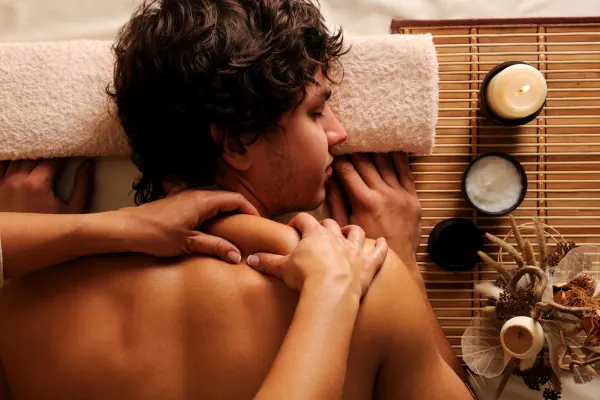
Before a first massage, the question is often less complicated than the debate around it: will I feel comfortable with this person? For some men, a male therapist feels like the easier choice. Others prefer a woman. Others have no preference at all.
That choice deserves room. It does not need a story about masculinity, attraction or what every man supposedly wants. The useful conversation starts with the person receiving the service: the experience they want, the boundaries they need and the questions they have not yet felt able to ask.
Comfort is a preference you can name.
You might want someone whose communication feels familiar, someone you have seen before, or someone experienced with the service you want. A same-gender practitioner can feel easier for one client and less comfortable for another. Neither response is a personality test.
A simple request is enough: “I would prefer a male therapist. Is that possible?” You can ask the same question about a female therapist or say that gender does not matter to you. The provider can explain availability without asking you to defend your identity.
Choosing a therapist does not establish a client’s sexual orientation. Being gay, straight or bisexual also does not tell a practitioner what pressure, conversation or clothing arrangements someone wants. Those details belong in an actual conversation.
What the research can actually tell us.
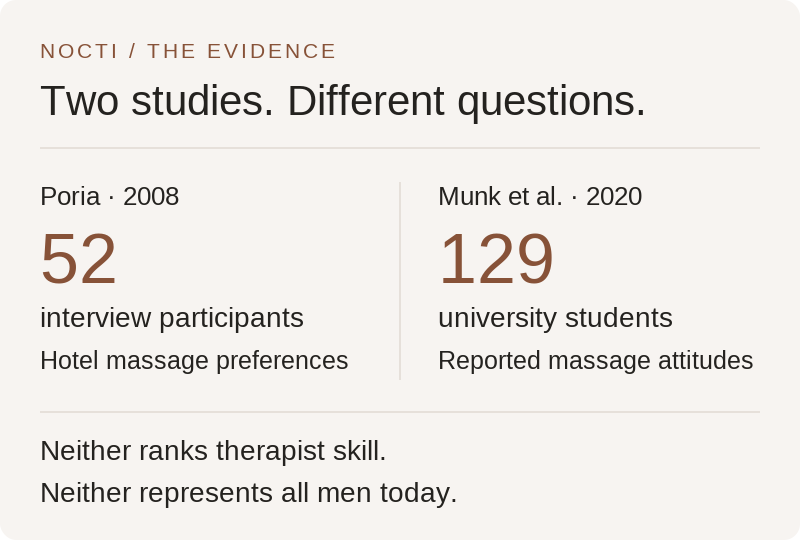
An exploratory study published in 2008 interviewed 52 people about choosing a male or female hotel massage practitioner. Preferences were tied to several things: the purpose and type of massage, gender expectations, companions and comfort with an unfamiliar person’s touch. It examined meanings and experiences; it did not establish how most men choose today.
A 2020 survey at one U.S. university included 129 undergraduate preprofessional health sciences students. The authors reported an opposite-sex therapist preference more often among male than female respondents: 38.9% versus 2.1%. That finding does not support a blanket claim that men prefer male therapists.
The university sample was small and specific, and an attitude questionnaire is not a record of real bookings. Neither study tested whether male or female therapists deliver better treatment. Together, they offer a reason to ask about individual preference rather than market a stereotype as a scientific conclusion.
Open full-size graphic ↗
A photograph cannot tell you the pressure.
A larger hand or a slower touch may be something you personally enjoy. It is still worth separating that preference from the prediction that a larger or male practitioner must deliver stronger, better work.
One public r/massage discussion describes a client choosing a larger male therapist for deeper pressure, while that therapist said his smaller female colleague preferred and excelled at deeper work. It is an anecdote, not an experiment, but it neatly exposes the assumption behind the booking.
Describe the sensation and service you want. “Slow, firm work, with room to adjust” gives a practitioner more useful information than “I need the strongest person.” Ask how they approach your requested areas and whether that style is part of their practice. A gentle session can be a deliberate choice, too.
A pressure check is useful communication. You do not have to endure an uncomfortable session to avoid seeming difficult, and a practitioner should not have to guess what your silence means.
Know the boundaries before the appointment.
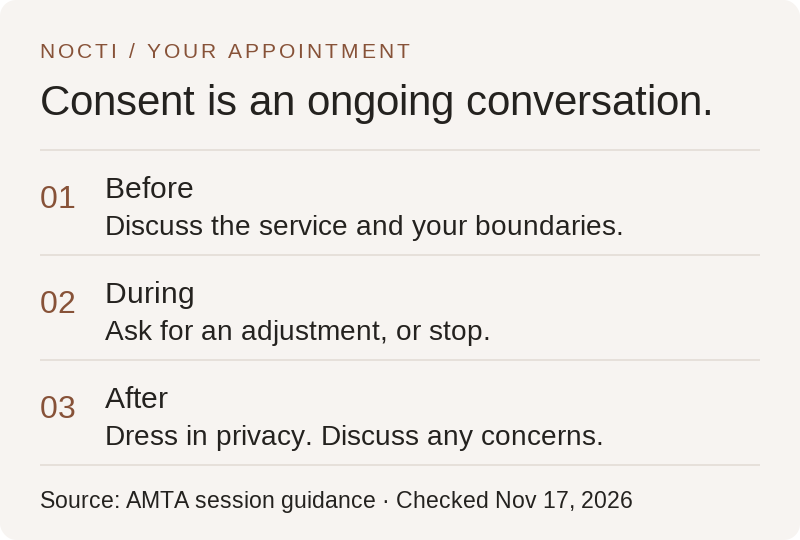
AMTA’s client guidance describes privacy while changing, clothing removal only to your comfort level, and draping that exposes the area being worked on. You can ask about the techniques, change the pressure, choose quiet and stop the massage.
Ask how those arrangements work for the particular service before arriving. A clothed session and an oil-based table massage may have different practical requirements. If the proposed setup does not work for you, discuss an alternative before consenting.
Open full-size graphic ↗
The awkward questions are often practical ones.
You do not have to arrive fluent in spa language. Ask where to put your belongings, whether you can keep clothing on, how the room is arranged and which areas will be included. Explaining a boundary before the session can make the rest of the appointment simpler.
Useful phrases include: “Please leave that area out,” “I would like a quieter session,” and “Could we use less pressure?” A clear request is more helpful than trying to signal discomfort indirectly.
For a studio or mobile visit, confirm the appointment length, full price, setup and cancellation terms in writing. A private setting should make the arrangements clearer, not leave you guessing what you have booked.
A thoughtful gift leaves the recipient a choice.
If a partner is booking the massage, ask the recipient what they prefer before choosing the practitioner. An appointment is a gift of someone’s time and personal space as well as money.
It is possible for couples to have different comfort levels around a service. The research reviewed here does not establish jealousy as a common reason for choosing a male therapist, and it should not become a marketing explanation for other people’s relationships.
A flexible gift or a conversation about the options can be more useful than a surprise appointment with an unfamiliar practitioner. The person receiving the massage should still be able to accept, adjust or decline it.
Keep the health promises proportionate.
NCCIH describes possible short-term benefits for some pain conditions, while noting that much of the evidence is limited or uncertain. That does not establish a need for every man to have regular massage, or that deeper pressure produces better outcomes.
Reported serious harms are rare but include nerve injury, fracture and blood clots; some reports involved vigorous massage or people at greater risk. More pressure is not automatically more care.
Discuss relevant conditions, injuries and medications with the practitioner. If symptoms are new or concerning, or you are unsure whether massage is appropriate, seek medical advice first. Do not use a wellness appointment to delay an assessment or replace prescribed care.
Choose a service you can describe.
A useful shortlist starts with what you actually want from the appointment. Relaxation, a familiar routine and focused bodywork are different requests. A men’s-focused service can make the questions easier to ask without implying that all men share the same needs.
Read the qualifications and service description, then ask anything the profile leaves unclear. A photograph can help you recognize someone; it cannot verify credentials, communication or fit. Check any claimed license or certification with the relevant issuing body.
The best next step may be a first appointment, another conversation or choosing someone else. Keep enough room in that decision for both personal preference and professional standards.
| Consider | Ask |
|---|---|
| Purpose | What does this session include, and does it match what I want? |
| Pressure | Can you describe your style and how we will adjust it? |
| Comfort | Can my practitioner preference and boundaries be accommodated? |
| Qualifications | Where can I check your credentials and relevant experience? |
| Practical details | What is the total price, session length and cancellation policy? |
A few useful answers.
Is it unusual for a man to request a male massage therapist?
A personal preference is a reasonable part of choosing a practitioner. It does not tell anyone your sexual orientation or create a rule about what other men should choose.
Are male therapists better at deep tissue massage?
The preference studies reviewed here did not compare clinical performance by gender. Ask about the individual practitioner’s techniques and experience instead of treating gender as proof of quality.
Can I keep my underwear on or ask for less pressure?
AMTA describes a client’s right to undress only to their comfort level and request pressure changes. Discuss any service-specific clothing requirements before the session.
Do all men need regular massage?
No universal schedule follows from the evidence reviewed here. Decide around your preferences, budget and health needs, with medical advice when appropriate.
About this article
An editorial review checked November 17, 2026. This is not a new study, medical assessment or clinician-reviewed treatment recommendation. The research and social account have different methods and cannot establish what all men prefer.
The cover illustrates a service. The original NOCTI graphics explain source methods and client choices; they are not photographs of study participants or evidence that a particular provider is effective. No original interviews or personal clinical experience are claimed.
Sources (5)Read moreRead less
- Poria — Gender and the choice of hotel massage practitioner (2008)
Exploratory qualitative study of 52 participants. The public abstract supports the summary; full-text access is restricted. No contemporary population estimate or treatment comparison.
- Munk et al. — Massage perceptions among university students (2020)
Cross-sectional survey, 129 students at one U.S. university. Measures reported attitudes, not actual bookings or provider effectiveness.
- Reddit — Look can be deceiving
Public first-person account, checked November 17, 2026. Not independently verified, representative or evidence of treatment benefit.
- AMTA — What to expect at your massage session
Professional association guidance on privacy, draping, pressure and consent.
- NCCIH — Massage therapy: What you need to know
U.S. National Institutes of Health summary of evidence, limitations and safety considerations.